If you’re a Chevrolet, Buick, or GMC dealer reviewing GM’s digital signage requirements, there is one thing I believe you should do before signing an agreement:
Read the requirements yourself. Then start asking questions.
Over the past several days, I’ve spoken with multiple GM dealers about their experiences reviewing digital signage proposals. What caught my attention wasn’t simply that they had questions—it was how similar those questions were.
Some dealers said their proposals included more screens than they believed their facilities required. Others were unsure whether additional products and services were required GM Digital Signage components, vendor recommendations, or optional add-ons. Several also raised concerns about pricing, support, the use of IMR funds, and contract terms that could tie their dealership to the same technology provider for as long as four years.
Those conversations are why I’m writing this.
This isn’t an argument against digital signage. When it’s used effectively, digital signage can be a powerful communication and sales tool inside a dealership.
The issue is much simpler: dealers should clearly understand what GM requires, what a vendor recommends, what is optional, and exactly what they are agreeing to pay for before signing a contract.
“I wanted the minimum required platform. Unfortunately, one of the vendors kept pushing additional systems, telling me they would be IMR approved and that I shouldn’t worry about it.”
That is a reasonable expectation. A dealer asking for the minimum required platform should receive a proposal that clearly identifies what is required. Any recommended upgrades, additional systems, or optional services should be labeled and explained—not presented in a way that makes them appear mandatory.
What Is the GM Digital Signage Program?
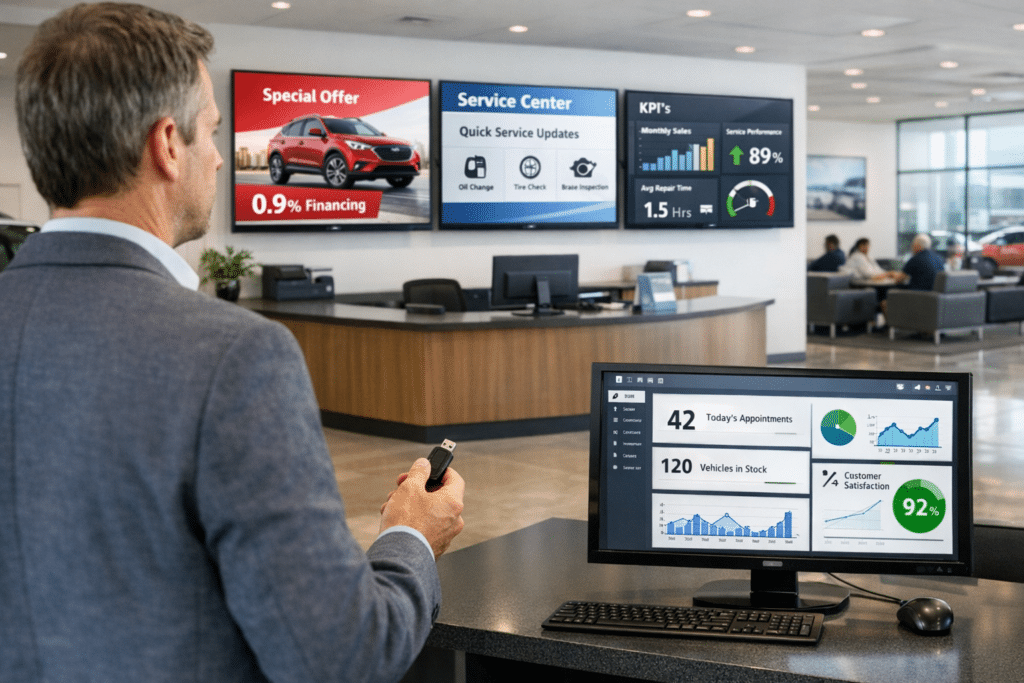
GM Digital Signage, commonly referred to as GMDS, is part of the broader dealership facility and customer-experience standards associated with GM’s Essential Brand Elements, or EBE, program. The displays are intended to help create a consistent in-dealership experience in customer-facing areas such as the showroom and service write-up area.
But here is the distinction I want dealers to keep in mind:
GM’s requirements and a vendor’s complete sales proposal are not necessarily the same thing.
A dealership may choose to purchase technology beyond GM’s minimum requirements, but each item in the proposal should be clearly identified as required, recommended, or optional.
GM Requirements vs. Optional Solutions: Know the Difference

This may be the most important distinction in this article: GMDS requirements establish what a dealership needs for compliance, while a supplier may recommend additional products that go beyond those requirements. Both may appear in the same proposal, but the difference should always be clear.
What Does GM Require in the Showroom?
GM’s published guidance considers the dealership’s facility layout and vehicle display areas when determining the appropriate number of showroom displays. Depending on the configuration, the requirement may generally range from one to four commercial displays, with the final number established through the dealership’s site survey and applicable GM documentation.
If a dealer is told, “You need ten showroom TVs,” the immediate follow-up should be:
“Show me where my GM site survey or GM documentation requires ten.”
A vendor may have good reasons for recommending ten displays when only four are required. The proposal should simply make that distinction clear:
Four required. Six recommended or optional.
What Does GM Require in the Service Area?
For grouped service write-up stations, GM guidance generally calls for one display for every two service desks or advisor stations. Individually separated offices, podiums, and other layouts may have different requirements.
If six advisors work from grouped stations, a dealer should not automatically assume that six separate displays are required. Ask the vendor to show how the number was determined and where it appears in the dealership’s site survey or GM documentation.
“I was told I needed one screen for every advisor, only to find out afterward that it wasn’t true. The vendor also wouldn’t update the service agreement.”
The dealership’s actual configuration and GM documentation—not the size of the vendor’s proposal—should determine what is required for compliance.
Required and Recommended Are Two Different Words
There is nothing wrong with a vendor recommending additional technology. If extra screens, a video wall, a sales leaderboard, or lounge television programming could improve the dealership experience, the vendor should explain the value and allow the dealer to decide.
The problem begins when the dealership cannot tell where GM required ends and vendor recommended begins.
“Some vendors are more interested in pushing extras than explaining the standard requirements. I told my vendor representative I wanted the minimum, but they continued pushing leaderboards, lounge TV, and more screens than required.”
Dealers should ask for their site survey and applicable GM documentation, then compare them directly with the proposal. Every product should be clearly identified as required, recommended, or optional.
The dealership may ultimately choose to purchase every additional product. What matters is that it is making an informed choice—not buying something because it was led to believe the product was required.
What Isn’t Required by GMDS?
Many digital products can add real value inside a dealership, including customer lounge TV, sales and service leaderboards, video walls, promotional displays, employee communications, custom content systems, and additional showroom or service displays.
At Digital Dealership System, we offer several of these solutions because we believe the right technology can improve communication, employee performance, the customer experience, and dealership profitability. But value and compliance are two different questions.
Unless a product is specifically identified in the applicable GM program documentation or the dealership’s site survey, it should be treated as an optional business decision—not a GMDS compliance requirement.
A dealer may decide that a lounge TV system, leaderboard, video wall, or another digital solution is worth the investment. Depending on applicable program rules, the dealership may also be able to purchase optional products and services from other suppliers.
The fact that an approved GMDS supplier sells a product does not automatically make that product a GM requirement. Dealers should evaluate optional solutions based on their value—not purchase them under the impression that they are required for compliance.
Understand What You’re Buying—and the Full Cost

When reviewing a GMDS proposal, I recommend asking the supplier for two numbers: the cost of the minimum configuration required for compliance and the cost of any additional equipment or services being recommended. Those numbers may be identical, or they may be very different. Either way, separating them makes the dealership’s decision much clearer.
A straightforward proposal could show:
GMDS Required Configuration: $X per month
Optional Dealer Enhancements: $X per month
Total Proposed Solution: $X per month
This is not about automatically choosing the cheapest system. Cheap does not always mean good, and expensive does not always mean bad. A dealership may intentionally choose premium commercial hardware, a larger installation, a video wall, a leaderboard, or Lounge TV because those products create a better experience or provide measurable value.
The important distinction is whether the dealership is choosing to buy more or has been led to believe it is required to buy more.
Look Beyond the Monthly Price
Dealers should understand exactly what each charge includes. Are you paying for the display, media player, software, content, support, subscription—or a combination of them? It is also important to ask whether recurring fees are based on the number of televisions or the number of independent media players.
If several displays are showing the same content, ask whether each one truly requires its own player and subscription. There may be valid technical reasons for that configuration, but the technology requirements—not the supplier’s billing model—should determine the system’s design.
Finally, calculate the cost over the full agreement term. A monthly payment can make a large commitment appear smaller than it is. A $1,000 monthly charge becomes $48,000 over 48 months, while monthly packages of $5,000, $8,000, and $10,000 become $240,000, $384,000, and $480,000 over four years.
Those totals do not automatically mean the investment is too expensive or the wrong decision. They simply give the dealership the information needed to evaluate the full financial commitment and decide whether each part of the proposal makes business sense.
Understand the Commitment Before You Sign

A four-year agreement is a significant commitment for any service, but it can feel especially long when technology is involved. Over 48 months, software, hardware, OEM programs, dealership needs, and customer expectations can all change. A store may be sold or acquired, a provider’s service may decline, or another approved supplier may introduce a better solution.
“Why should I be forced to sign a four-year agreement? Technology changes, requirements change, and economic conditions vary. In today’s market, a vendor commitment longer than a year seems unreasonable. But the representative is telling me I need to sign it to remain compliant.”
That is exactly the kind of concern a dealer should address before signing. Ask whether the full agreement term is actually required for GMDS compliance or simply part of the supplier’s contract structure.
Know Your Exit Options
Even when a solution works well today, dealers should understand what happens if circumstances change. Before entering a multi-year agreement, review the provisions covering early termination, buyouts, dealership sales, ownership changes, OEM program changes, service obligations, hardware replacement, and provider performance.
Also ask whether the agreement can be transferred and what happens if you want to move to another approved supplier. A contract should not become interesting only when you are trying to get out of it.
Understand Who Owns the Equipment
Dealers should also compare the cost of leasing or financing the equipment with the option to purchase it upfront. Ask who owns the televisions and media players, what is actually being financed, and what happens to the equipment when the agreement ends.
It is also important to know whether you can continue using equipment you have already paid for or change software providers without replacing functional displays. The answers can significantly affect the long-term cost and flexibility of the proposal.
“IMR Eligible” Does Not Mean “Free”

GM’s IMR program gives dealerships funds that can be used for eligible programs and services, but IMR eligible does not mean free. Every dealership has a limited amount available, and dollars spent on one program cannot be used again for advertising, marketing, or other eligible expenses that may provide a different return.
“When someone says it’s covered by IMR, it can sound like it doesn’t cost anything. But we only have so much money available. If we spend it here, we can’t spend that same dollar somewhere else. It’s not the same as receiving a discount.”
Consider the Opportunity Cost
When reviewing a digital signage proposal, dealers should separate the required GMDS components from optional products such as lounge TV, leaderboards, additional displays, and other services. Those additions may be valuable, but the dealership should understand how much of its available IMR budget they will consume.
Dealers should also determine what happens if eligible expenses exceed their available funds, including who is responsible for the difference and how the overage will be billed.
The question should not simply be:
“Can this be billed through IMR?”
It should also be:
“Is this the best use of my IMR dollars?”
Those are two very different questions.
Support Matters More After the Sale
Pricing often gets the most attention before a contract is signed, but support becomes far more important afterward—especially when the agreement lasts several years. Dealers should understand who to contact when something breaks, what telephone, remote, or onsite support is included, how quickly failed hardware will be replaced, and what happens when a media player fails or content stops updating. Any guaranteed response times, service levels, and remedies for unresolved problems should be clearly stated in the agreement.
Existing Customers Should Review Their Current Agreement First
Dealers with an existing digital signage system should be especially careful before signing a new contract. If a supplier says that support, replacement equipment, or continued service requires another long-term commitment, I recommend slowing the conversation down and reviewing the current agreement first.
Ask what support you are already entitled to receive, why a new contract is necessary, and whether it will replace or extend the existing agreement. Dealers should also determine whether they are being asked to refinance equipment they have already paid for or replace hardware that may still be functional. Get those answers in writing before signing anything new.
“We already had the system and had been paying for it for a while. What frustrated me was being told that the only way to receive service for the TVs that were out was to start over with another long-term commitment and all-new hardware. That doesn’t even address the content issues and delays we experienced.”
Optional Products Should Earn Their Place

A vendor recommendation is not automatically a General Motors requirement. There may be good reasons to invest in technology beyond the minimum, and at Digital Dealership System, we often recommend additional solutions when we believe they can solve a problem or produce measurable value. That is what vendors should do: bring ideas, explain the benefits, demonstrate potential ROI, and earn the business.
But optional products should be evaluated on their own merits. Whether it is lounge TV, a sales leaderboard, a video wall, or additional showroom displays, dealers should not approve the investment simply because it can be bundled with a required OEM program or included on the same invoice.
When something is required, show the requirement. When it is optional, call it optional and make the business case.
Every optional product should have to earn its place in the dealership.
Dealer Choice and Competition Matter
GM dealers currently choose from a limited group of approved digital signage suppliers. That makes it especially important for dealers to compare the differences between providers, including pricing, technology, service, contract terms, hardware options, support, flexibility, and optional products.
GM has every right to establish technical, brand, security, and performance standards for companies participating in its programs. At the same time, expanding the approved-provider list could give dealers more alternatives, encourage innovation, improve service, create more flexible contract options, and place healthy pressure on pricing.
A competitive marketplace benefits the entire dealer body. The goal should be simple:
Set a high standard, then allow qualified companies to compete to meet it.
The Message to GM Dealers

Before signing a GMDS agreement, I recommend reading the applicable requirements, reviewing your site survey, and asking the vendor to identify—in writing—which parts of the proposal are required for compliance and which are recommended or optional. Ask why each additional screen or service is included, then compare approved providers based on more than the monthly price. Technology, support, equipment ownership, contract terms, and flexibility all matter.
Look at the entire financial commitment. What will the agreement cost over its full term? How much of your available iMR budget will it consume, and how much of that spending is tied to required components versus optional services? You should also understand what happens if GM changes the program, you sell the dealership, the provider’s service falls short, or you decide to switch vendors.
A three- or four-year agreement may make business sense when the value justifies the commitment. But dealers should be cautious about signing a long-term technology contract simply because they were told it was necessary for compliance. Ask to see the requirement, understand your support and exit options, and make sure every part of the proposal earns its place.
Your dealership may change over the next 48 months. Technology almost certainly will.
If the answers make sense, move forward. If they don’t, keep asking questions.
A Message to General Motors
From the conversations I’ve had, GM dealers are not asking to avoid brand standards. They are asking for greater clarity, competition, and choice when meeting them.
Dealers should be able to answer a few basic questions before signing a GMDS agreement: What does GM specifically require at this facility? Can the dealer easily access the applicable site survey? Which products are required for compliance, and which are optional? Is a three- or four-year agreement necessary to meet GM’s standard, or is that simply a supplier’s contract structure?
When dealers are limited to a small group of approved providers, the pricing, support, contract terms, and accountability of those providers become especially important. Concerns about unclear proposals, long-term commitments, equipment ownership, iMR spending, or difficulty changing providers deserve attention—particularly when dealers believe those terms are required by GM.
Clearer dealer-facing documentation would help. So would requiring suppliers to separate the GMDS-compliant minimum from optional dealer enhancements in every proposal. Dealers should also understand what happens if GM changes the program, a dealership changes ownership, or a provider fails to meet its service obligations.
The objective should be straightforward:
Clearly define the standard. Make the minimum requirement easy to understand. Allow qualified providers to compete. Then let dealers decide which optional products and services are worth the investment.
Most importantly, dealers should never have to guess where a GM requirement ends and a vendor recommendation begins.
Read the requirements. Ask the questions. Compare the options. Then decide.