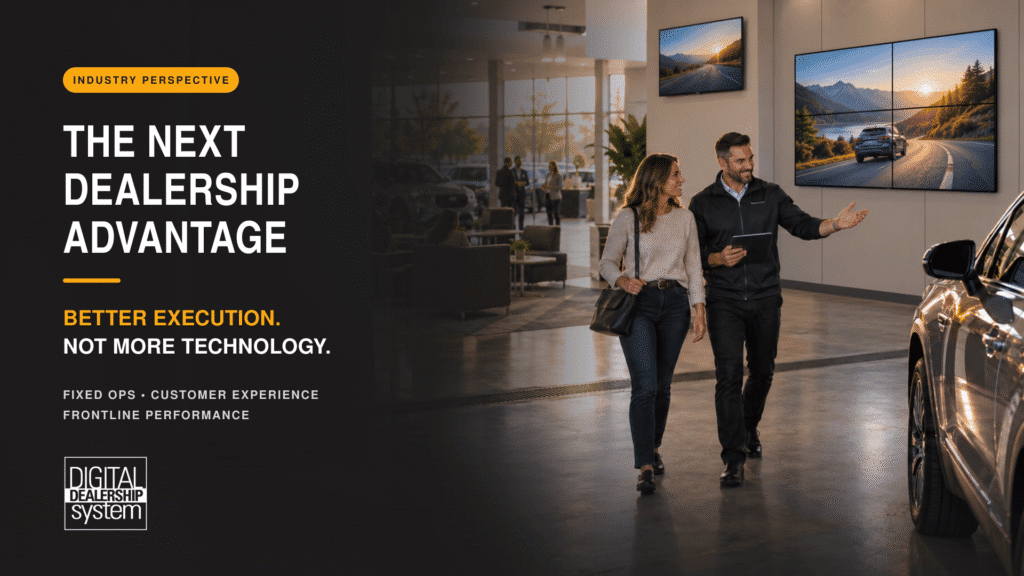

I walk into dealerships all the time, and one thing I keep seeing is a wall of TVs across the showroom, lounge, or service drive all playing random sports channels, daytime TV, or whatever happened to be turned on that day.
At first glance, many people do not think of this as a big deal.
But it is a big deal.
Because when I look at those screens, I do not just see background entertainment. I see part of the customer experience. And in many stores, those screens are reinforcing the exact experience customers already dislike.
Think about the two biggest complaints customers have in dealerships. One is that the sales process takes too long. The other is that staff seem distracted or not fully engaged. So when a customer walks into a showroom full of noisy, inconsistent, irrelevant screen content, what message are we really sending?
We are telling them, whether we mean to or not, that the experience is scattered, unfocused, and not built around them.
That matters more than most dealers realize.
We Spend a Lot to Get Customers in the Door — But What Happens After That?
Dealerships are spending more than ever to get customers through the door. In many cases, advertising costs are now over $700 per unit sold.
But here is the truth I keep coming back to: advertising does not sell cars on its own.
People sell cars. Process sells cars. Product sells cars. Experience sells cars.
So the real question is not just how much you are spending to drive traffic. The real question is: what kind of experience are you delivering once that customer actually shows up?
If you are investing heavily in paid search, third-party listings, digital ads, and marketing campaigns, but the in-store experience feels disconnected or unprofessional, then you are creating friction at the exact moment when trust should be building.
Every Screen in a Dealership Is Either Building Trust or Eroding It
I believe every touchpoint matters inside a dealership.
And every screen matters too.
Every moment a customer spends in your showroom, waiting area, service lounge, or service drive shapes how they feel about your store. Those moments either build or erode trust.
The best dealerships understand that screens are not there just to fill space or kill time. They are part of the dealership experience. When they are used intentionally, they can entertain, educate, inform, upsell, and reinforce professionalism. When they are used poorly, they become noise. They distract staff, confuse customers, and weaken the message the dealership should be sending.
That is why I do not look at screens as an afterthought. I look at them as one of the most overlooked assets in the store.
What I Saw at Audi Fort Lauderdale and Audi Coral Springs
When I first met John Jones, the GM of Audi Fort Lauderdale and Audi Coral Springs, his stores looked like many others I had seen.
The screens were inconsistent. The content was outdated. Streaming was wasting bandwidth. And at one point, a Mercedes video was even playing in his Audi showroom.
That is not just a branding issue. That is an experience issue.
Customers may not consciously remember every detail they saw on a screen, but they absolutely feel whether a dealership environment is polished, intentional, and aligned or chaotic, disconnected, and careless.
That is where John made a different decision than most people do.
Most GMs talk about customer experience. John decided to invest in it.

What Changed When the Dealership Became Intentional
Once John made that decision, the stores became much more deliberate about what customers were seeing throughout the dealership.
Instead of random programming, every screen started serving a purpose.
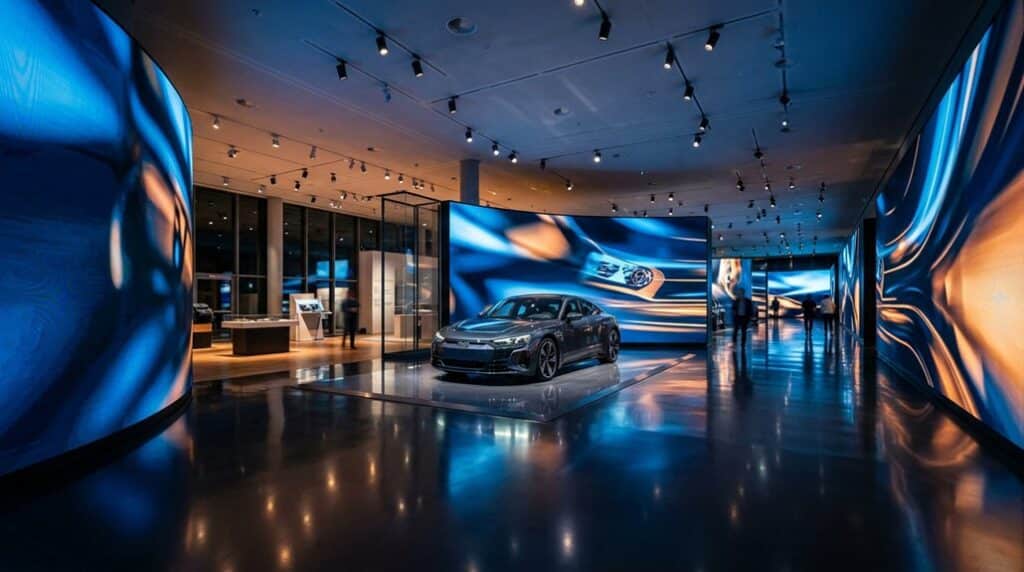
Now the stores have consistent, branded content across every screen. They use QR-driven engagement for inventory, trade values, and lead capture. They blend service status updates with marketing content. They provide family-friendly, pre-screened lounge entertainment. And they use real-time, DMS-connected communication to keep customers informed.
That is what effective dealership digital signage should do.
It should support the customer journey, reduce uncertainty, and make the store feel modern, organized, and customer-focused.
Customer Experience Alone Is Not Enough
What I also respected about John’s approach is that he did not stop with the customer experience.
He invested in his team, too.
Many dealerships still rely on weekly meetings to review performance. I think that is backward. You cannot drive daily performance with weekly data.
John already had access to reports through his DMS, CRM, and corporate tools. But I have said this many times: reports do not motivate people. Static data does not create urgency. It does not drive action in the moment.
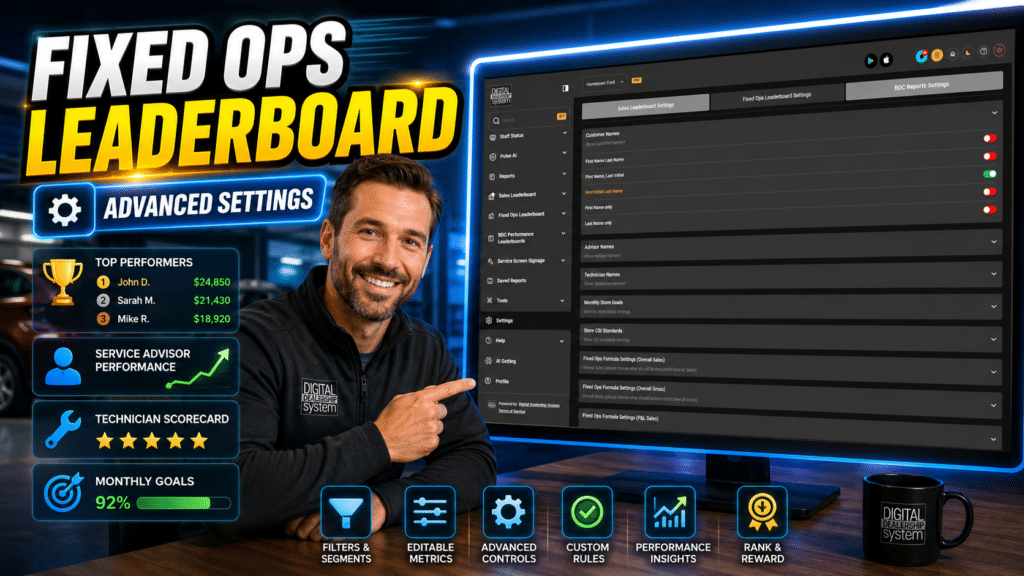
So he implemented live, DMS-connected leaderboards across both Sales and Fixed Ops.
Now his team can see units, gross, goals, and other KPIs in real time on mobile devices, desktops, and TVs in manager towers and in break rooms.
That kind of visibility changes behavior.
What Happens When Teams Can See Performance in Real Time
When dealership teams can see their performance in real time, accountability increases. Engagement strengthens. A culture is built.
Instead of waiting for a meeting to hear where they stand, people know where they stand every minute of the day.
That creates competition. It creates awareness. And it creates better performance.
This is why I believe dealership leaderboards and performance dashboards are so powerful. They turn information into action. They make goals visible. They keep people engaged in the moment. And they create a culture where performance is not something you talk about once a week. It is something your team sees and responds to all day long.
None of This Required a Massive Overhaul
One of the biggest takeaways from this example is that this was not some massive reinvention of the dealership.
It was a decision.
It was a decision to stop saying, “We care about the customer experience,” and actually invest in it.
That investment improved two things at the same time: the in-store customer experience and the visibility and performance of the team.
And the cost was small compared to the total advertising spend.
In this case, it was less than 2% of total advertising spend to completely change what customers experienced in the store and what employees saw every day.
That is not a major expense. That is a smart reallocation of resources toward the part of the sales process that customers and employees are actually living in.
If You Ignore the In-Store Experience, You Are Wasting Marketing Dollars
I think this is where many dealerships miss the mark.
If you are spending heavily to get customers in the door, but ignoring what happens once they are inside, then you are not maximizing your investment.
In some cases, you are doing worse than that.
You are reinforcing the exact reasons customers do not come back.
Customer experience is not defined by what a dealership says in its advertising, on its website, or in its mission statement. It is defined by what the dealership actually does every minute, on every screen, with every interaction.
That is where trust is built.
Or lost.
My Final Take on Dealership Customer Experience
Dealership customer experience is no longer just about having friendly staff and a clean showroom. It is about whether every part of the environment is working together to support trust, communication, and performance.
Screens should not be distractions.
They should be assets.
When your content is intentional, your communication is real-time, and your team has visibility into performance, the dealership operates differently. Customers feel it. Employees feel it. And the results reflect it.
If you want better outcomes, do not just look at your advertising spend. Look at what your customers and employees actually experience when they walk into the building.
Because every screen is saying something about your dealership.
Make sure it is saying the right thing.
~Todd Katcher