Fixed ops managers have a lot to track every day: sales, gross, RO count, hours sold, appointments, advisor performance, technician productivity, and more.
The problem is not that the data does not exist. The problem is that it is often hard to find, hard to compare, or scattered across multiple tools.
The Service Manager at Audi Fort Lauderdale, Alex Robles, says he had to pull 6 different pages from CDK to get the reports he wanted to see. Now the same data is live in our system and already preformatted.
Fixed Ops Business Intelligence from Digital Dealership System gives dealership management a clearer view of what is happening across the service department, so leaders can make faster decisions while the day is still moving.
Key Takeaways
Business Intelligence gives managers a clearer view of fixed ops performance.
Leaders can review essential service department numbers without having to jump between multiple reports.
Store-level reporting helps leadership see the big picture.
Sales, gross, RO activity, appointments, hours, ELR, and performance trends are easier to understand in one place.
Advisor reporting makes coaching more specific.
Performance can be compared across key areas, giving leaders better context for one-on-one conversations.
Technician reporting helps track productivity.
Leaders can see where hours are being produced and where technician performance may need support.
Better visibility helps teams act sooner.
When performance is visible in real-time throughout the day, leaders can coach, adjust, and recognize wins before the opportunity is gone.
Managers Need a Faster Way to See Fixed Ops Performance
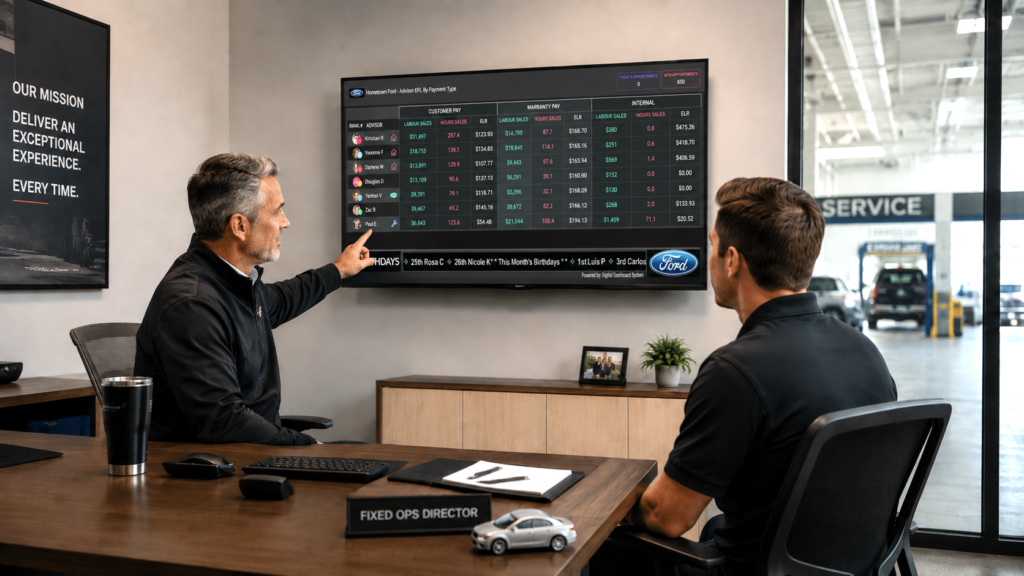
In fixed operations, performance metrics change every hour.
RO count changes. Labor sales change. Hours sold change. Appointments change. Effective labor rate changes. Advisor and technician performance can also shift quickly.
When managers have to wait until the end of the day, the next morning, or the end of the month to review performance, they lose valuable time.
By then, the best chance to coach may already be gone.
A service manager should not have to spend the morning building reports before they can lead the team. A fixed ops director should not have to open multiple windows to evaluate where the department stands for the month’s goals.
Business Intelligence helps solve that problem by giving managers a cleaner view of the numbers that matter most.
Instead of spending extra time searching for information, leaders can quickly review performance and decide where their attention is needed.
Store-Level Reporting Shows the Big Picture
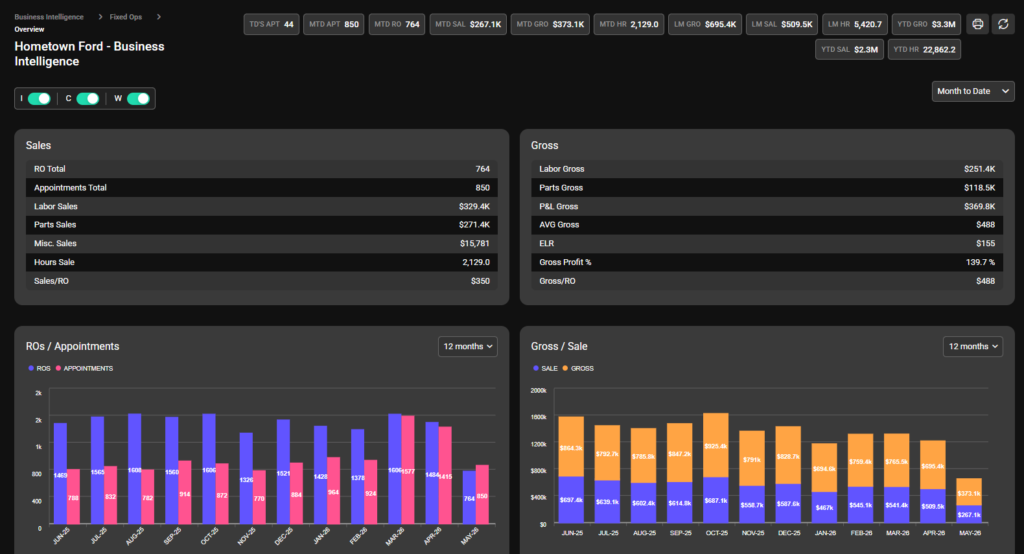
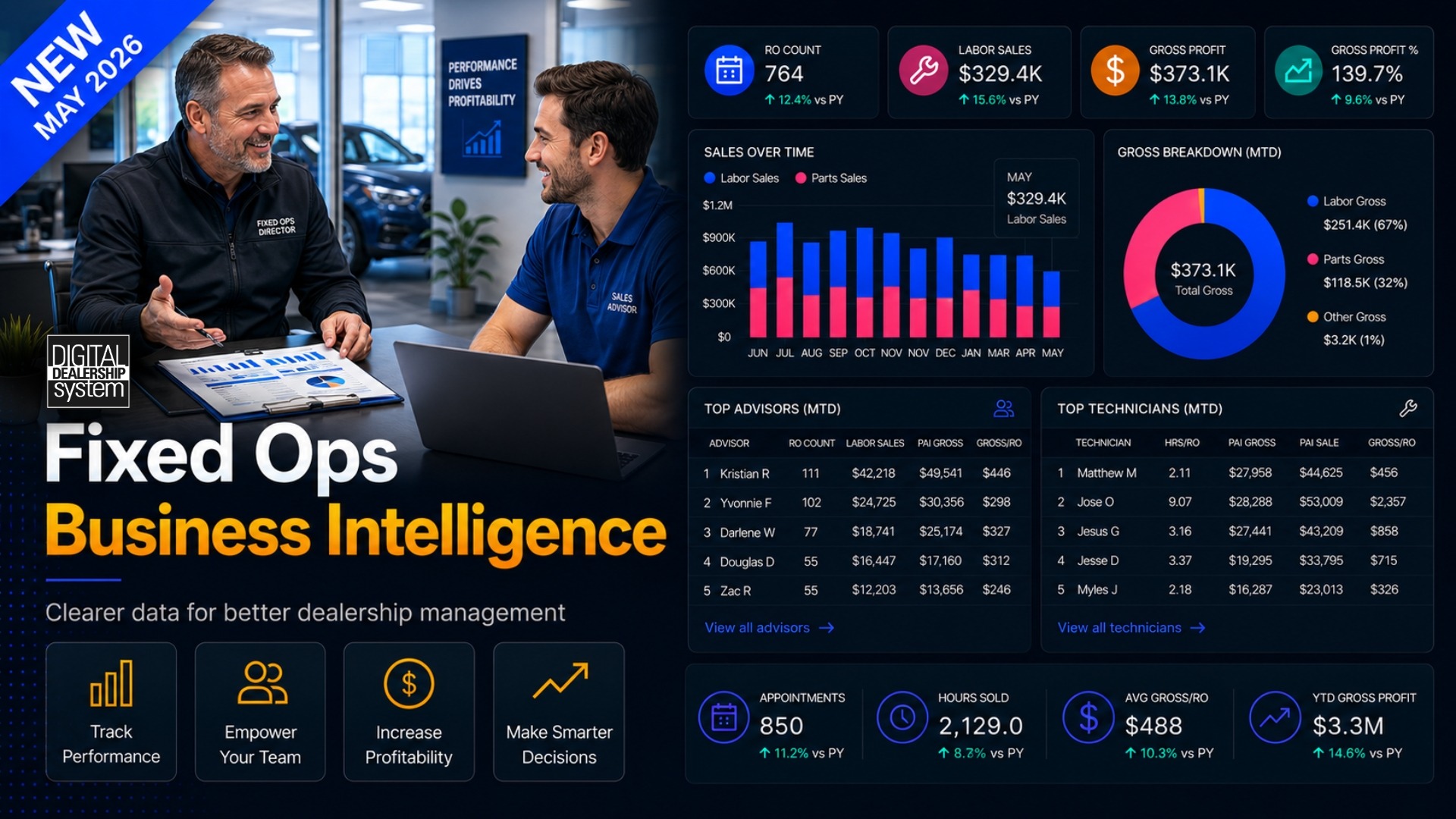
The Fixed Ops Business Intelligence Overview gives managers a high-level view of service department performance.
This can include sales, gross, RO activity, appointments, hours, effective labor rate, gross per RO, sales per RO, and trend charts.
For dealership management, this view answers a simple question:
How is the department doing right now?
A store-level report helps managers quickly see whether the service department is moving in the right direction. It can show whether performance is on pace, whether activity is slowing, or whether certain numbers need action.
Without that overview, managers may have to piece together the story from several different reports.
That is time-consuming and makes it difficult to draw the right conclusion.
With a clear Business Intelligence Overview, leaders can start with the big picture before digging into the details. This is helpful for service managers, fixed ops directors, general managers, and anyone responsible for understanding store performance.
The value is not just seeing more numbers. The value is seeing the right numbers in a format that is easier to review and digest.
Advisor and Technician Reports Make Coaching More Specific
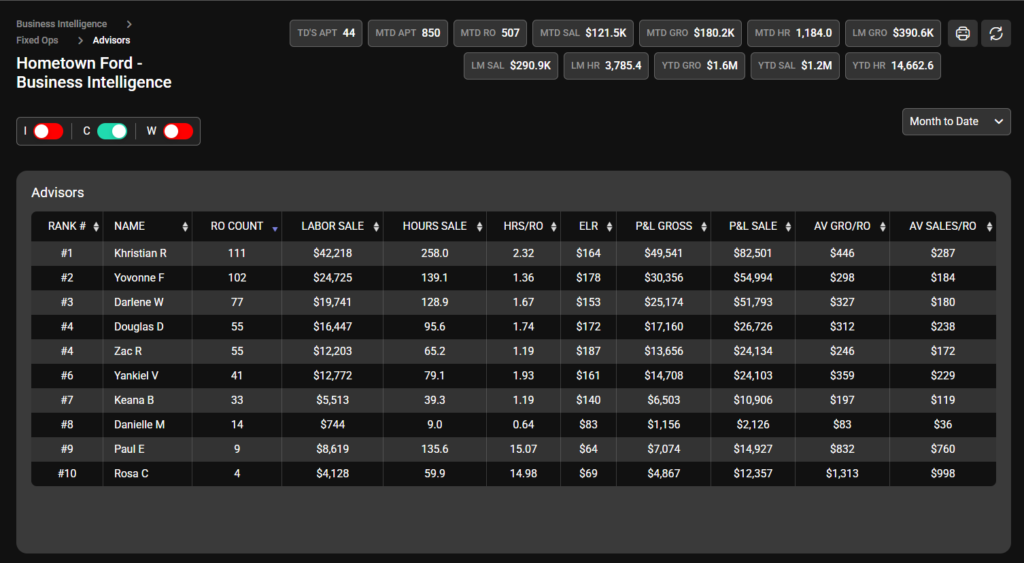
Store-level numbers are important, but they only tell part of the story.
Managers also need to understand performance for individual advisors and technicians.
Advisor-level Business Intelligence helps managers compare performance across areas like RO count, labor sales, hours sold, hours per RO, effective labor rate, gross, sales, average gross per RO, and average sales per RO.
This gives management a better way to coach the advisor team.
Instead of saying, “You need to improve,” a manager can have a more specific conversation.
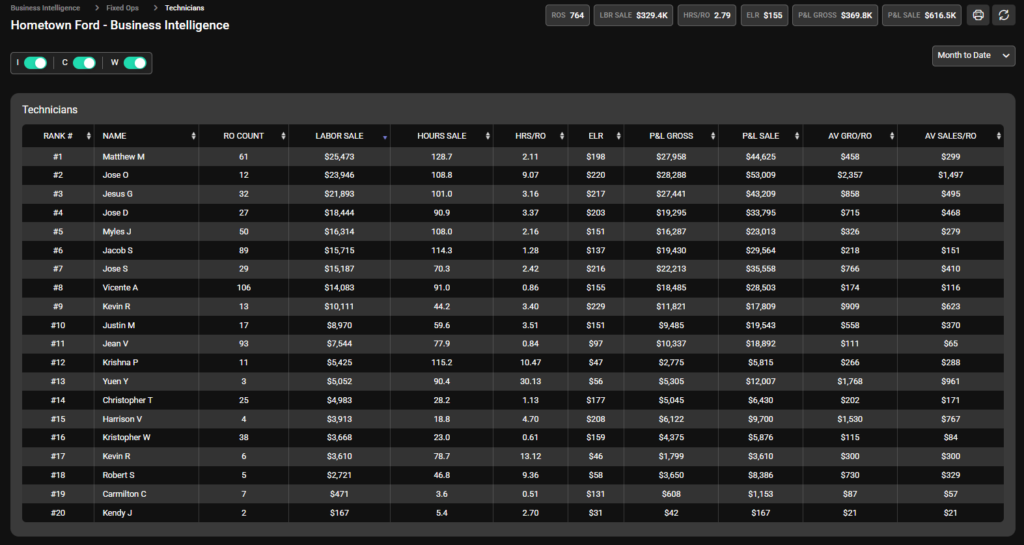
Technician-level Business Intelligence gives managers a similar view of technician performance.
For example, one technician may have a strong RO count but lower hours per RO. Another technician may need coaching to improve effective labor rate. And another tech may be performing well and deserves recognition while the performance is still fresh to keep the momentum.
It can help leaders see where hours are being produced, how productivity is moving, and where performance may need support. This can help with coaching, workload discussions, shop leadership meetings, and overall fixed ops planning.
The goal is not to shame people or micromanage every number.
The goal is to make coaching clearer, fairer, and more useful.
When managers have better individual-level reporting, they can coach based on facts rather than guesses or assumptions.
Better Visibility Helps Managers Act Before the Day Is Over
One of the greatest values of Business Intelligence is timing.
A report is more useful when managers can act on it.
If a manager sees a problem after the day is over, the day is already lost. They can talk about what happened, but they cannot change the result.
If they see the issue midday, they have options.
They can adjust focus. They can speak with an advisor. They can review technician productivity. They can check whether the department is on pace. They can recognize someone who is performing well. They can bring the team back to the right priorities.
That is why real-time, easily accessible visibility matters.
Fixed ops management is not just about reviewing what happened yesterday. It’s about guiding and coaching the team in real-time.
Business Intelligence helps turn reporting into a leadership tool. The reports are not just there to show numbers. They are there to help managers make decisions, support the team, and keep the department moving toward its goals.
Fixed ops managers do not need more complicated reports. They need clearer reports that help them lead.
Fixed Ops Business Intelligence from Digital Dealership System helps dealership management see store performance, compare advisor and technician results, and act on the numbers while they still matter.
Better reporting helps managers lead better.
Schedule a demo to see how Digital Dealership System helps fixed ops managers turn clearer reporting into faster decisions, better coaching, and stronger performance.