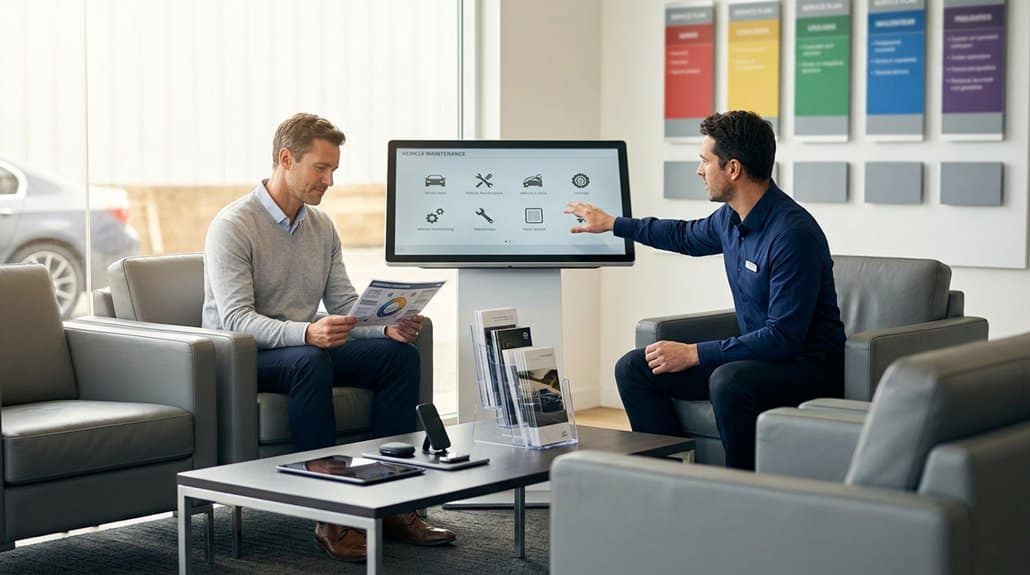
You can turn wait-time into predictable service revenue by layering targeted education, in-lobby tech, and automated nudges that convert curiosity into purchases. Use tablets and kiosks to show short, personalized videos and demos tied to service history, display real-time status updates, and offer comfy amenities to boost engagement. Train advisors to use data-driven scripts and automate scheduling and offers via texts. Track KPIs and A/B tests to measure lifts—keep going to learn the practical playbook.
Key Takeaways
- Use in-lobby digital displays and tablets to show short, targeted videos explaining recommended services and vehicle features.
- Send automated, personalized text/app updates with transparent estimates and real-time service status to build trust and reduce anxiety.
- Offer brief live demos or scheduled workshops on EVs and maintenance that highlight upsell opportunities and practical benefits.
- Integrate sales, finance, and service data to deliver tailored content and offers based on vehicle history and customer preferences.
- Measure engagement and revenue per content variant, iterate experiments, and scale high-performing educational assets.
Quick Wins: Turn Wait-Time Into Revenue in Your Service Lobby
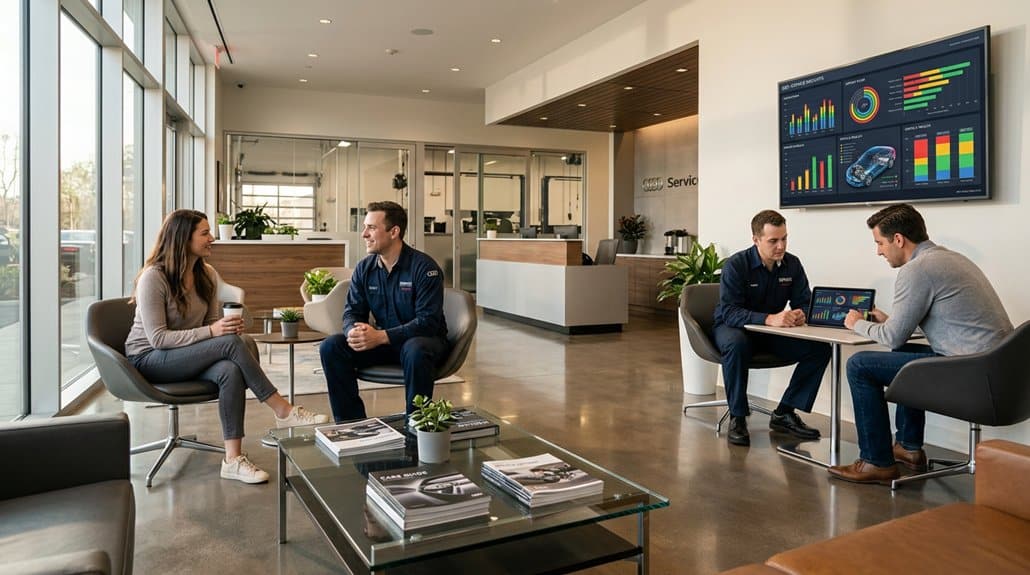
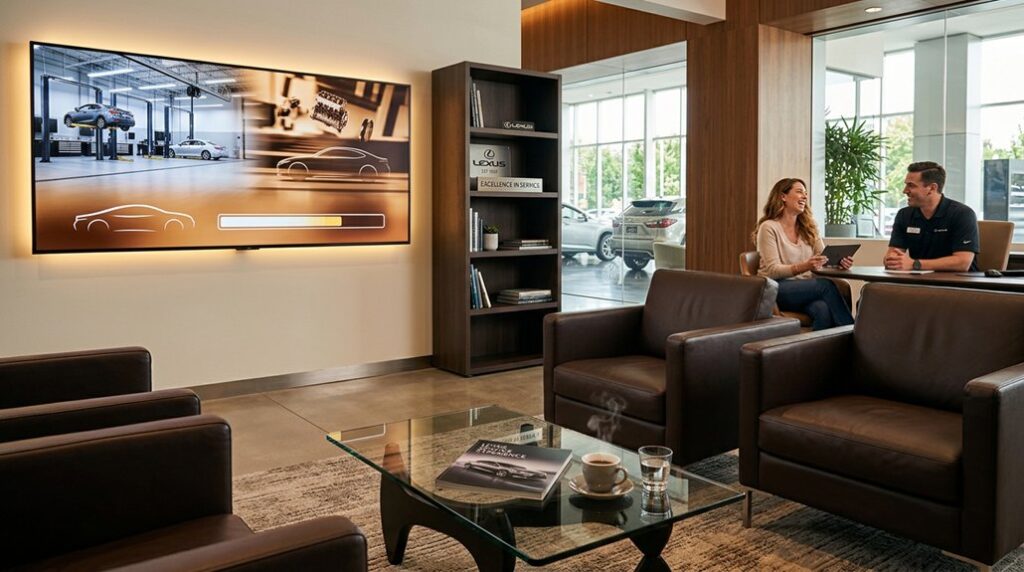
While customers wait, you can convert idle minutes into measurable revenue by layering digital touchpoints, targeted offers, and comfort amenities in your service lobby. You’ll boost customer engagement with interactive screens and tablets that deliver service education on vehicle features and upcoming maintenance, turning curiosity into informed decisions. Automated service communication—texts and app alerts—keeps patrons updated, raising satisfaction and customer retention. Comfortable seating, refreshments, and Wi‑Fi improve the waiting experience and reinforce brand loyalty, increasing repeat visits. Run short demos or workshops on advanced tech to create upsell opportunities during visits. Use data-driven insights to personalize in-lobby promotions and discounts on recommended services, converting wait-time into immediate revenue while tracking engagement metrics for continuous optimization.
Create a 5-Piece Content Menu for Service-Lobby Engagement
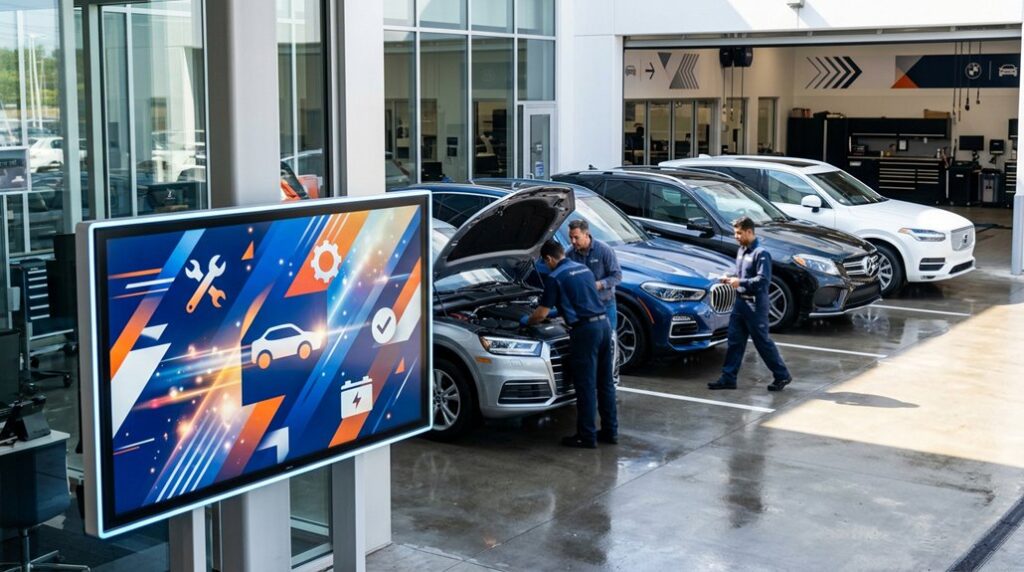
Because customers are captive in your service lobby, you should offer a concise 5-piece content menu that converts wait-time into trust and revenue: 1) Interactive Kiosks with short educational videos on advanced vehicle features — videos lift conversions by 86%, so prioritize concise, actionable clips. 2) Refreshment Areas with complimentary drinks and reliable Wi‑Fi to lower perceived wait times and improve satisfaction metrics. 3) Digital Displays showing real-time service status and estimated completion to increase transparency and reduce anxiety about costs. 4) Informative Brochures that summarize maintenance benefits and service options, reinforcing retention and repeat visits. 5) Educational Workshops—brief, scheduled sessions on EVs or new tech—to deepen knowledge and drive informed upsells. Measure engagement and iterate by content performance.
Choose In-Lobby Tech: Tablets, Kiosks, and Content Platforms That Fit Your Menu
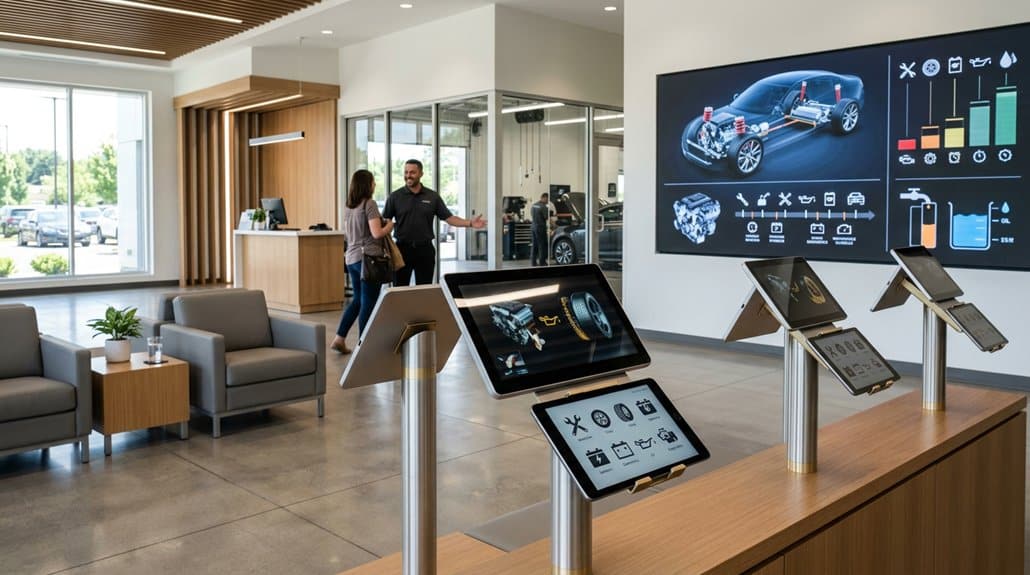
When you pick in-lobby tech, prioritize tools that map directly to your 5-piece content menu—tablets for quick surveys and personalized promos, kiosks for interactive demos and feature videos, and a content platform that schedules workshops and streams short, actionable clips; this combo cuts perceived wait time, boosts engagement, and makes upsells measurable. Choose tablet selection that’s rugged, secure, and optimized for fast surveys and feedback mechanisms. Design kiosk integration to deliver feature walkthroughs and targeted promo triggers. Use content customization to rotate short clips and workshop signups based on observed interests. Track customer engagement metrics and session lengths to inform service personalization. Stay current with technology trends—Wi‑Fi, responsive UI, and analytics—to improve user experience and operational ROI.
Personalize Service-Lobby Interactions With Unified Customer Data
Tech in the lobby is only as effective as the customer context behind it—unified data lets you turn those tablets, kiosks, and content platforms into personalized touchpoints that speak to each driver’s history and preferences. You’ll use data integration to combine sales, finance, and service records, producing customer insights that power personalization strategies and real-time service recommendations. That reduces perceived wait time, counters concerns about overcharging, and boosts customer experience and loyalty drivers. Present targeted engagement tactics—timed videos, estimate comparisons, and prompts for feedback loops—to educate without pressure. Track outcomes to refine personalization strategies and demonstrate ROI. Below is a simple view of how unified data maps to lobby actions.
| Data Source | Lobby Touchpoint | Outcome |
|---|---|---|
| Service history | Tailored videos | Reduced anxiety |
| Sales prefs | Feature demos | Higher engagement |
| Pricing records | Transparent estimates | Trust increased |
Train Advisors to Convert Curiosity Into Trusted Advice
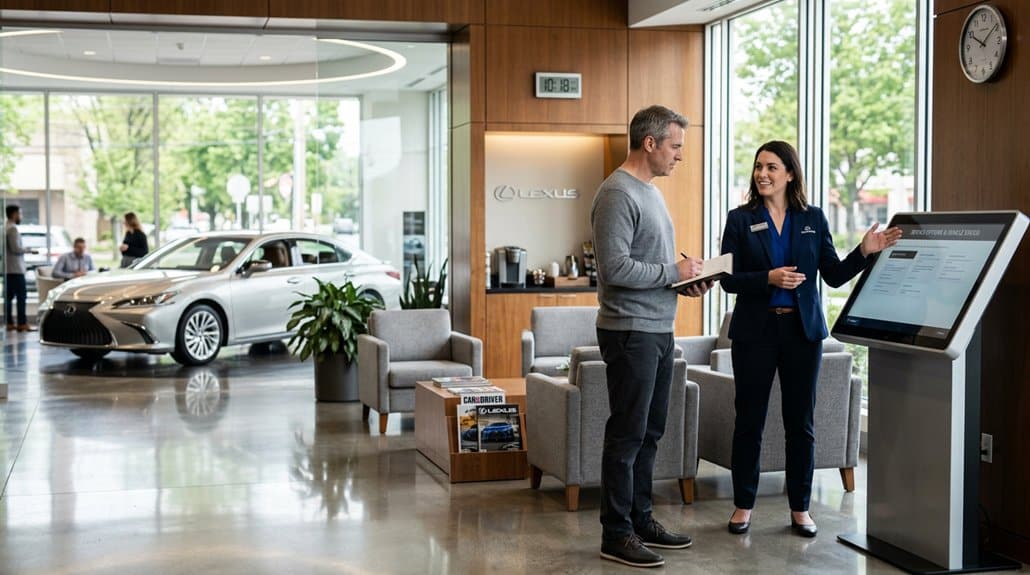
If advisors are trained to turn customer curiosity into clear, data-backed recommendations, you’ll see higher conversion and greater trust at the service desk. You’ll focus training on service knowledge and effective communication so advisors answer technical questions—like ADAS behavior—with confidence. Use customer engagement metrics and service history data to craft personalized recommendations that match real needs, not generic pitches. Regular role playing scenarios let advisors rehearse upselling strategies and handle objections without sounding scripted. Pair new staff with mentors to share conversion tactics; mentorship benefits include faster skill adoption and consistent trust building. Track outcomes—conversion rate, average repair order, and satisfaction—to refine coaching and keep recommendations measurable and customer-centered.
Automate Nudges for Waiting Customers (Scheduling, Offers, Status)
Advisors who convert curiosity into clear recommendations shouldn’t be the only touchpoint while customers wait—automated nudges keep communication constant and productive. You can deploy automated engagement to send status updates, scheduling links, and targeted offers without tying up staff. Real-time notifications reduce perceived wait times and keep customers informed about progress.
Give customers self-service options—online scheduling and status checks—since 72% prefer them, and you’ll free advisors for higher-value conversations. Use AI-driven personalized reminders and offers based on service history to increase add-on uptake and loyalty. Automated reminders about maintenance and promotions simplify decisions and boost repeat visits. By streamlining touchpoints with nudges, you improve productivity, raise customer engagement, and increase conversion rates for additional services.
Measure Impact: KPIs, A/B Tests, and Revenue Lifts to Track
You should track conversion rate from waiting-room contacts to actual service decisions to see which educational touches move the needle. Run controlled A/B tests on messages and formats—personalized reminders versus generic alerts—to identify what boosts engagement and uptake. Use those results to quantify revenue lifts and iterate on the highest-performing approaches.
Track Conversion Rate
Anyone interested in improving your service-drive ROI should start by rigorously tracking conversion rates—measure how many waiting customers become pre-qualified contacts, booked service appointments, and actual sales from educational touchpoints. You’ll map conversion strategies to specific KPIs: pre-qualified contact rate, appointment conversion, customer satisfaction scores, and revenue lift per program. Track engagement signals (video views, quiz completions) to tie customer engagement to downstream conversions. Run regular audits of those metrics to spot drop-offs in the funnel and prioritize fixes that boost throughput. Report revenue lifts from targeted educational interventions to justify investment and scale what works. Use time-bound cohorts and clear attribution windows so you can confidently correlate education efforts with measurable service-revenue gains.
Run Controlled A/B Tests
When you run controlled A/B tests, you’ll isolate specific variables—messaging, video vs. infographic, wait-area prompts, or upsell scripts—and measure their impact on KPIs like appointment conversion, post-service retention, NPS, and revenue per repair order; track engagement metrics (view-throughs, quiz completions), run tests on time-bound cohorts with clear attribution windows, and report statistically significant revenue lifts so you can scale winning treatments and retire losers. You’ll use A/B test strategies and KPI benchmarking to link educational content effectiveness to dollars. Combine engagement metrics tracking with customer feedback analysis to refine service content optimization. Set testing frequency determination based on sample size and seasonality. Log revenue impact assessment per variant, retire losers, and roll out winners across locations to boost retention and ROs.
- Define hypothesis, KPI, cohort
- Run time-boxed experiments, capture metrics
- Analyze feedback, quantify revenue lifts
Scale and Keep Content Fresh: A Repeatable Playbook for Long-Term Loyalty
To scale efficiently, you should build a content-repurposing playbook that turns one core asset into videos, quick guides, and onboarding scripts so you’re not recreating the wheel each month. Pair that with an evergreen topic framework that prioritizes high-value subjects (maintenance, safety features, seasonality) shown to influence 46% of service decisions. Then automate distribution cadence across waiting-room screens, email, and your app to sustain the 86% engagement lift and drive repeat visits.
Content Repurposing Playbook
Because customers rarely digest long technical manuals, you should repurpose high-value assets—like educational videos on advanced features—into bite-sized formats (short clips, infographics, interactive guides) that match audience preferences and platform behavior. Use audience segmentation and customer data to map content formats to buyer needs, ensuring brand consistency across touchpoints. Prioritize visual storytelling to boost retention (colored visuals raise read willingness by 80%) and set feedback loops to measure comprehension and service uptake. Define a content lifecycle with scheduled refreshes for EV and emerging-tech topics. Allocate resources based on performance metrics so resource allocation supports top engagement strategies. A repeatable playbook streamlines production, reduces waste, and drives measurable increases in service sales.
- Short clips + social snippets
- Infographics + service sheets
- Interactive guides + in-lobby kiosks
Evergreen Topic Framework
Although evergreen content needs minimal upkeep, you’ll still need a repeatable framework to scale and keep it relevant: prioritize high-impact topics (safety systems, EV charging, ADAS calibration), map each to micro-formats (30–90s clips, FAQ cards, kiosk interactives), and set cadence-based refresh triggers (quarterly for software/firmware changes, semiannual for policy/pricing shifts). You’ll use customer engagement metrics and feedback loops to refine topics, tie digital signage and interactive experiences to service personalization, and integrate AI-driven insights for targeted educational resources that boost loyalty programs.
| Topic | Micro-format | Refresh trigger |
|---|---|---|
| Safety systems | 60s clip + FAQ card | Quarterly |
| EV charging | Kiosk interactive | Semiannual |
| ADAS calibration | Demo clip | Quarterly |
| Maintenance tips | FAQ carousel | Semiannual |
Automated Distribution Cadence
You’ve mapped evergreen topics and micro-formats — now set a repeatable, automated cadence that delivers the right content to the right customer at the right moment. You’ll use automated notifications tied to service milestones and wait-time triggers so educational pieces reach customers when they’re most receptive. Data-driven segmentation feeds personalized micro-formats, boosting customer engagement and satisfaction metrics. Schedule regular content refreshes in your playbook to keep material relevant and measurable. Track open, view, and conversion rates to refine timing and topics. A scalable workflow reduces manual effort while increasing trust and repeat visits, turning passive waiters into informed buyers.
- Trigger-based automated notifications for timely delivery
- Data-driven segmentation for personalized content
- Scheduled refreshes to maintain relevance and lift engagement
Frequently Asked Questions
What Is the 30 60 90 Rule for Cars?
The 30-60-90 rule for cars is a follow-up schedule: within 30 days recommend essentials, at 60 days focus on car maintenance options, and by 90 days offer upgrades or warranties to boost customer engagement and retention.
How Much Does a Car Salesman Make on a $30k Care?
You’d typically earn about $2,000–$3,000 on a $30k car, depending on commission structure and sales incentives; variations include flat fees or tiered rates, plus bonuses that can raise total compensation further.
What Is the 4 Square Trick Car Dealers?
It’s a worksheet that compares vehicle price, trade value, financing, and monthly payment; you’ll see numbers shifted, you’ll see totals tweaked. Use customer engagement strategies and service appointment optimization to spot manipulation and negotiate smarter.
What Is the $3000 Rule for Cars?
The $3000 rule says you should aim for total annual ownership — including car depreciation and maintenance costs, fuel, insurance — to be about $3,000 or less, so you’re choosing a financially sensible, low-cost vehicle.
Conclusion
Don’t let wait-time be wasted: you can turn the lobby into a revenue engine by combining five targeted content types, simple in-lobby tech, and advisor coaching. Remember—customers who interact with in-store service content are 65% more likely to accept recommended repairs, so every minute matters. Start small, measure uplift with clear KPIs, automate timely nudges, and scale what works. Do this and you’ll boost revenue, satisfaction, and long-term loyalty.