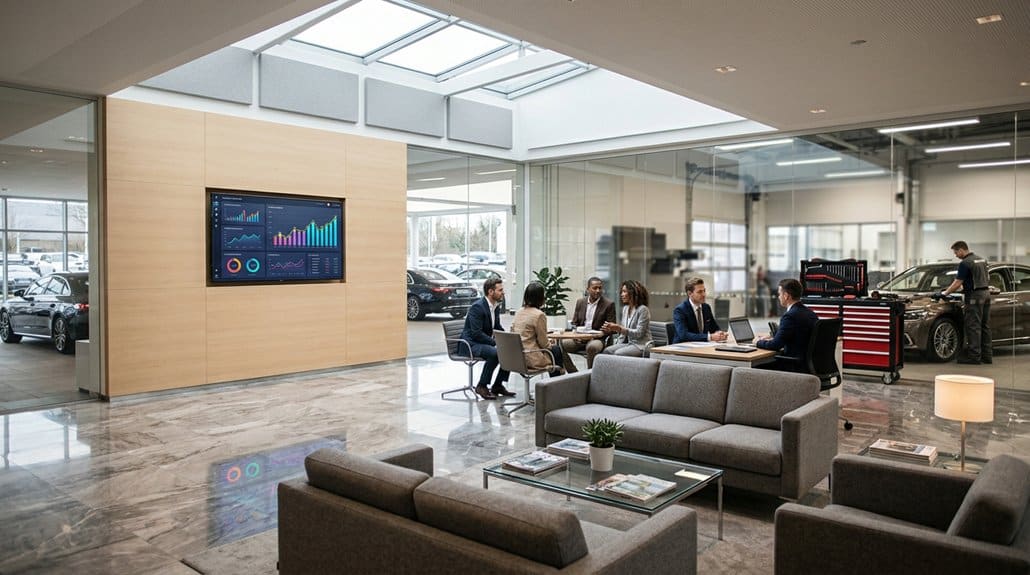
You can boost service revenue 10–25% by using lounge TV to shorten perceived wait times, increase engagement, and drive targeted upsells. Map peak waits, schedule short promo and maintenance segments, and rotate content weekly to keep impressions fresh. Track view duration, promo redemptions, and booking conversions, then optimize playlists and pricing for sponsored slots. Integrate with CRM to attribute revenue and measure ROI, and keep testing timing and offers to refine performance further.
Key Takeaways
- Use short, targeted promo slots with clear CTAs and QR codes to drive immediate service bookings and upsells.
- Schedule dealership-branded content every 7–10 minutes to increase brand recall and repeat service visits.
- Rotate educational maintenance tips and vehicle spotlights to reduce perceived wait times and boost conversion intent.
- Measure view duration, promo redemptions, and CRM tie-ins to attribute revenue and optimize programming.
- Sell sponsored local-ad slots to monetize screens while protecting against competitor messaging.
Quick 3‑Step Plan to Boost Service Revenue With Lounge TV
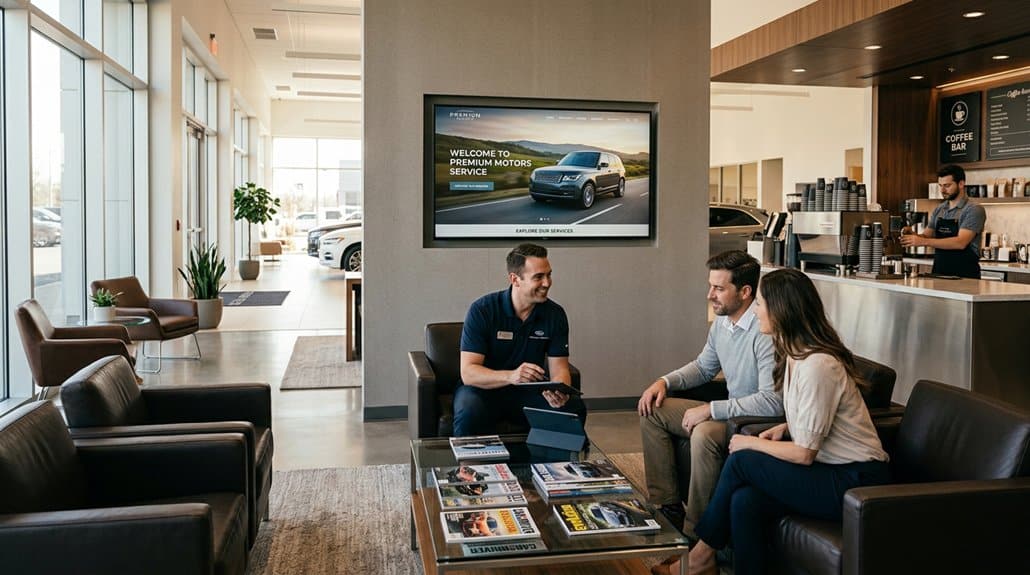
Start with three clear steps to turn your lounge TV into a measurable revenue driver: 1) Audit and schedule — map peak wait times, deploy a dealership-specific Content Strategy focusing on Visual Storytelling that highlights service specials and vehicle upgrades. 2) Measure and optimize — track Engagement Metrics (view time, click-throughs, feedback) and iterate programming; data shows reducing perceived wait times boosts satisfaction and repeat visits. 3) Monetize and protect — sell Sponsored Advertising Opportunities for complementary vendors while keeping competitor ads out to preserve Brand Loyalty.
You’ll align Lounge TV content with Customer Experience goals, use analytics to drive Revenue Growth, and convert short, targeted segments into measurable upsell opportunities without disrupting operations.
How Lounge TV Cuts Perceived Wait Time and Raises Engagement
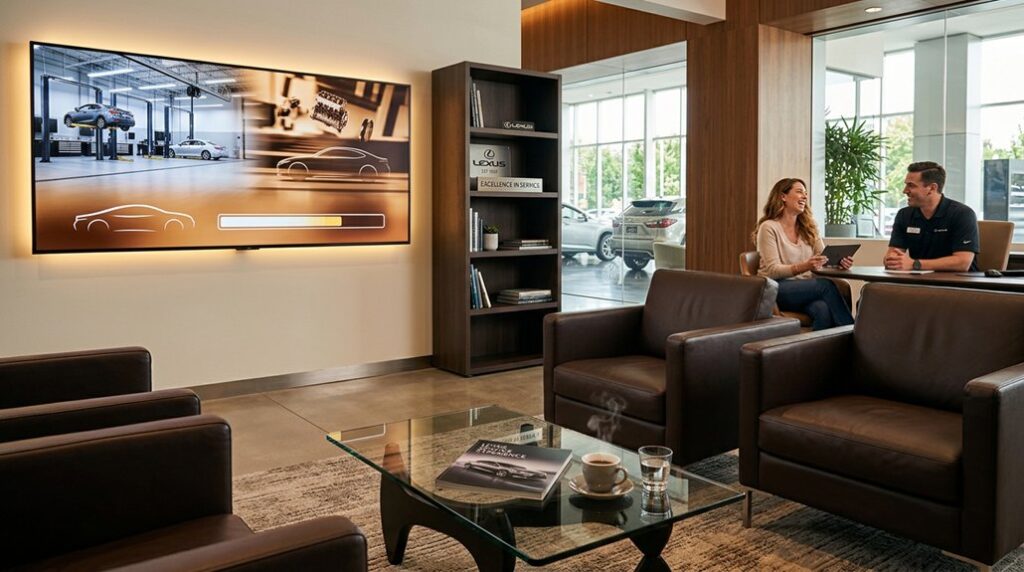
You can cut perceived wait times by up to 33% with engaging lounge-TV content, directly improving customer satisfaction metrics. Use targeted, regularly refreshed programming to keep viewers informed about services and prevent competitor messaging from distracting them. A disciplined content strategy that mixes educational segments and dealership-specific spots boosts engagement and reinforces brand recall during service visits.
Reduce Perceived Wait
Although wait times are often unavoidable, well-designed lounge TV programming can cut perceived wait by up to 33%, directly boosting customer satisfaction and reducing perceived service friction. You’ll improve the waiting experience and customer comfort by deploying concise, curated segments—short educational clips, family-friendly shows, and service tips—that make time feel productive. Operationally, rotate content regularly to keep impressions fresh and eliminate competitor exposure, reinforcing your brand message. Measure impact with simple KPIs: perceived wait surveys, dwell time, repeat-service rate, and average ancillary spend. Implementing a schedule of varied, targeted content reduces complaints and streamlines throughput by lowering perceived friction, which raises engagement and repeat business. That data-driven approach converts a passive wait into a revenue-supporting touchpoint.
Boost Viewer Engagement
Having cut perceived wait with concise, rotated programming, the next step is boosting viewer engagement to lock in those gains and drive measurable outcomes. You’ll capitalize on data showing engaging visual content can reduce perceived wait by up to 33% by aligning playlists with viewer preferences and operational goals. Implement short, targeted segments to maximize retention and limit competitor exposure, increasing dwell-time loyalty metrics. Schedule regularly updated educational clips and family-friendly shows to convert idle time into productive brand interactions and upsell opportunities. Track engagement KPIs—average view duration, repeat exposure, and post-visit conversions—to quantify impact. Prioritize content diversity to serve demographic peaks and test variants rapidly; iterate based on performance to continuously improve satisfaction scores and service revenue.
Content That Converts: Promos, Maintenance Tips & Vehicle Showcases
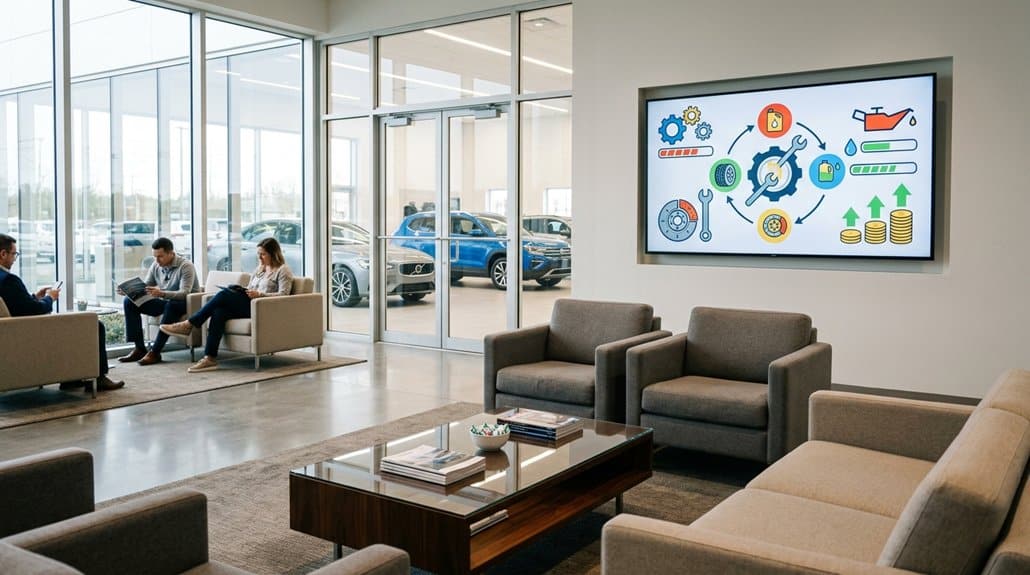
Use dedicated promo slots to push time-sensitive offers and service bundles that data shows increase service revenue when viewed during wait periods. Pair short, actionable maintenance tips with CTAs to boost recommended service uptake and customer satisfaction. Feature one vehicle spotlight per rotation to target demographics and drive showroom interest without increasing perceived wait time.
Promo Slots That Sell
Start with a few high-impact promo slots per hour that rotate service specials, quick maintenance tips, and short vehicle showcases so you can measurably boost on-site conversions during wait times. Design each slot around proven promotional strategies and viewer psychology: use clear calls-to-action, time-limited offers, and visuals that highlight benefits. Schedule promos when dwell time peaks and vary length to maintain attention; track impressions and engagement rates to identify top performers. Replace low-performing creatives weekly to prevent habituation and improve perceived value. Pair vehicle showcases with targeted service offers to increase cross-sell lift. Use analytics dashboards to quantify conversion uplift, A/B test messaging, and operationalize winners into rotation rules so your lounge TV becomes a predictable revenue generator.
Quick Maintenance Tips
When customers wait, brief, actionable maintenance tips — 20–30 seconds each, delivered 3–4 times per hour — boost informed service acceptance by simplifying decisions and reducing perceived risk. You’ll use data from viewership analytics to rotate tips that address common maintenance myths, target demographics, and recent service trends. Operationally, schedule concise clips tied to measurable KPIs: increased add-on sales, appointment conversions, and average repair order. Update content weekly to prevent fatigue and raise retention; test A/B variations to find the highest-converting messages. Pair tips with time-limited promos to convert interest into immediate bookings. Train staff to reference on-screen tips during consults, reinforcing customer education and shortening decision cycles. This disciplined, metrics-driven approach raises service revenue predictably.
Featured Vehicle Spotlights
After rotating short maintenance tips to educate and convert, shift some of that same airtime to featured vehicle spotlights that tie inventory and promos directly to waiting customers’ needs. You’ll use Customer Lounge TV to present data-driven vehicle trend highlights, targeted promotions, and concise specs so customers make informed buying decisions during service downtime. Visual showcases improve brand recall and drive inquiries; regular updates keep content aligned with inventory and seasonal demand. Track play frequency, dwell time, and promo redemption to quantify impact on customer engagement and conversion rates.
- Rotate top-trending models weekly with promo overlays.
- Pair spotlights with relevant maintenance offers.
- Measure CTR via QR codes and short URLs.
- Refresh content based on sales and service analytics.
How Often to Update Playlists & Schedule Content Blocks
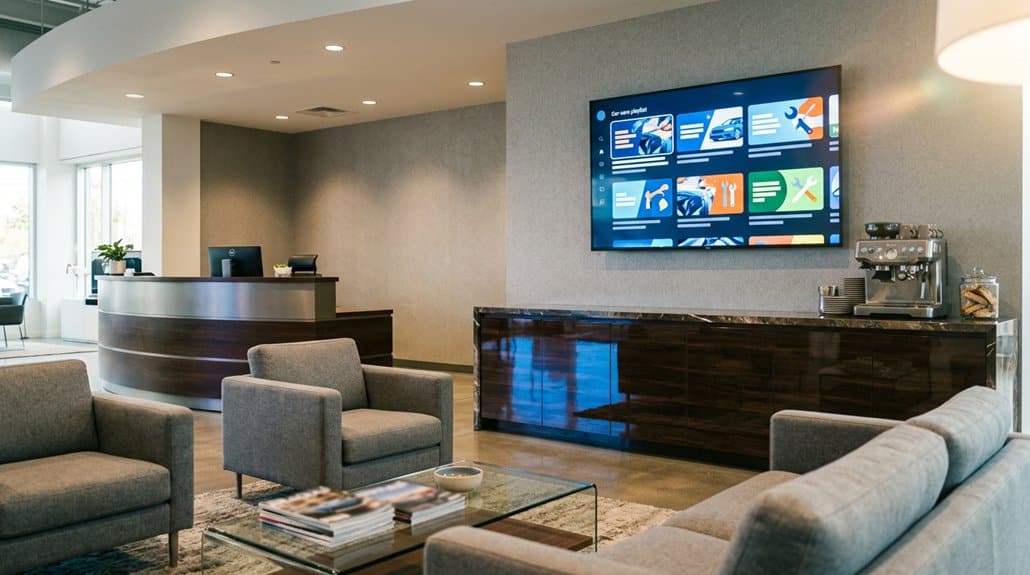
Regularly updating playlists—ideally on a monthly cadence—keeps content fresh and can reduce perceived wait times by up to 33%, while allowing you to incorporate timely manufacturer videos, promotions, and seasonal messaging. Set playlist frequency to monthly with weekly micro-adjustments for promotions; this balances operational effort and impact. Schedule content blocks by service lane demographics, aligning runtime and topics to customer segments to maximize content alignment and relevance. Use a disciplined content calendar and rapid customization process so teams can swap assets for events or inventory changes within 24–48 hours. Run A/B tests on 2–4 block variants per month, measure retention and engagement, then iterate. Track KPIs (dwell time, conversion inquiries) and adjust cadence based on results, not intuition.
Use Lounge TV to Reinforce Brand, Offers & Service Messaging
Use your lounge TV to put service promotions front-and-center with short, branded spots that align to current offers and technician availability. Data shows engaging visual content can reduce perceived wait time by up to 33%, increasing customer receptivity to upsells and service bookings. Consistently branded creative and customer testimonials will build recognition and trust while driving measurable upticks in service inquiries.
Reinforce Service Promotions
One straightforward way to boost service revenue is to run dealership-specific promotions on your lounge TVs, since visually prominent offers during average wait times of 45–60 minutes increase recall and upsell conversion. You’ll improve service visibility and customer engagement by scheduling targeted, rotating promotions that align with peak service flow and inventory.
- Feature time-limited offers (oil, tire, inspection) with clear call-to-action to book before leaving.
- Use data-driven sequencing: prioritize high-margin services based on recent purchase patterns.
- Update creative weekly to maintain attention and reinforce retention of specials.
- Track conversions by unique TV promo codes or QR-scannable scheduling links to measure ROI.
This operational approach turns passive wait time into measurable upsell opportunities.
Drive Brand Recognition
After running targeted service promos on your lounge TVs to lift immediate upsells, you can also leverage the same screens to build longer-term brand recognition by consistently airing dealership-branded spots, service messaging, and value propositions during average 45–60 minute waits. Use curated programming to replace competitor ads and repeatedly expose customers to your logo, service packages, and core values—research shows repeated exposure drives recall. Schedule short branded segments every 7–10 minutes so guests encounter messaging multiple times per visit. Rotate content to spotlight seasonal offers, new services, and warranty messaging while tracking engagement and upsell conversion rates. This operational cadence strengthens brand loyalty, reduces leakage to competitors, and supports measurable customer retention through consistent, informative touchpoints.
Monetize Lounge TV: Sponsored Slots & Local Partnerships
While you’re keeping customers comfortable, monetizing your lounge TV with sponsored slots and local partnerships turns idle attention into measurable revenue—trackable metrics like view duration and click-through rates let you price inventory based on real engagement, and rotating, locally relevant ads both boost incremental income and reinforce community goodwill. You’ll structure packages for sponsors, set frequency caps, and use analytics to demonstrate advertising effectiveness to partners. Local business collaborations expand inventory and deepen community ties while keeping content fresh. Monitor performance weekly and adjust rates to demand.
- Define slot pricing by view duration and CTR benchmarks.
- Offer bundled local business collaborations for cross-promotion.
- Rotate ads to sustain engagement and maximize CPM.
- Report metrics monthly to sponsors and refine offers.
Implementing Lounge TV: Setup, Hardware & Staff Workflow
Because setting up Lounge TV is straightforward, your team can be live in hours—not days—by choosing plug-and-play hardware, a cloud-based CMS, and a simple staff workflow for uploading branded videos and building playlists. You’ll capitalize on lounge tv benefits: reduced perceived wait times (up to 33%), consistent branding, and improved customer experience. Minimal training lets staff update content and schedule automatic refreshes to avoid competitor ads. Prioritize family-friendly, educational clips and integrate service status and promos into playlists to keep customers informed and engaged. Track metrics (views, dwell, CTA clicks) and iterate weekly.
| Item | Purpose | Time to Deploy |
|---|---|---|
| Media Player | Playback, CMS sync | 15 min |
| Display | Viewing experience | 10 min |
| CMS | Content management | 5 min |
| Training | Staff upload/playlists | 30 min |
| Automation | Auto-update content | 10 min |
Integrate Lounge TV With Your CRM for Proactive Sales
If you tie Lounge TV into your CRM, you get real-time service appointment data that lets you surface personalized videos, promos, and service recommendations while customers wait—driving higher conversion and smoother follow-up. You’ll use CRM Integration to push appointment context to screens, enabling Personalized Messaging and Service Promotions tailored to each guest. Data Utilization guarantees content aligns with service history and predicted needs, improving Customer Engagement and repeat visits. Sync monthly Content Strategy updates with CRM segments to focus on high-value Upsell Opportunities and streamline technician-to-sales handoffs for Sales Alignment. Automated follow-up sequences triggered by viewing behavior close the loop and preserve operational efficiency.
Tie Lounge TV to your CRM for real-time, appointment-driven videos, personalized promos, and automated follow-up that boosts conversions.
- Real-time appointment-driven content
- Segment-based personalized promos
- Monthly CRM-synced content refreshes
- Automated, view-triggered follow-up
Measure Impact: KPIs, Viewing Analytics & Revenue Attribution
Metrics are how you’ll prove Lounge TV moves the needle: track viewer retention, perceived wait-time reduction, content engagement by segment, and downstream service conversions to link screen time with revenue. Use viewer insights and viewing analytics to build monthly KPI dashboards that show revenue attribution, advertising effectiveness, and service upsell rates by customer segmentation. Tie engagement metrics (view durations, click-throughs on interactive screens) to CRM records for performance tracking and to validate retention strategies. Apply content personalization to increase relevance for high-value segments and to prioritize program optimization across time blocks. Report ROI and sponsored-slot pricing based on measured view durations and conversion lifts. Keep reports operational, action-oriented, and aligned to dealership revenue goals.
A/B Tests & Optimization Playbook for Timing, Content & Offers
Now that you’re tracking KPIs and viewer behavior, run structured A/B tests to optimize when and what plays in the lounge. You’ll apply A/B testing strategies to measure content effectiveness, viewer retention, and offer conversion. Test timing windows against peak wait times, swap educational clips versus promotional spots, and measure uplift in perceived wait time and bookings—results can boost service revenue up to 33%. Use retention curves and feedback to select winners, then scale successful variants across shifts. Iterate weekly with rolling cohorts and holdout controls to avoid seasonality bias. Document learnings to refine targeting and creative.
- Test peak vs off-peak promo timing
- Compare educational vs promotional clips
- A/B price/offer messaging
- Use viewer feedback in variant selection
Frequently Asked Questions
How Much Commission Does a Car Salesman Make on a $30,000 Car?
You’d earn about $1,500–$3,000 on a $30,000 car (5–10%); commission structure, bonuses and sales strategies can push this higher, with flat fees or tiered rates and upsell incentives boosting overall pay.
What Is the Most Profitable Department in a Car Dealership?
The service department is most profitable; you’ll see service department profitability driven by high gross margins (often ~50%+), and applying customer retention strategies boosts recurring revenue, absorption rates, and operational efficiency for sustained profits.
What Is the Hardest Month to Sell a Car?
February is the hardest month to sell a car. You’ll see seasonal trends of lower demand, fewer incentives, and higher inventory; adjust sales strategies by targeting promotions, optimizing staffing, and focusing on service revenue to offset declines.
How Do Car Dealerships Make Most of Their Profit?
Once, a service advisor turned a single oil change into a $400 bill; you make most profit from service departments, relying on customer engagement and service upselling, using data-driven processes to maximize parts, labor, and retention.
Conclusion
Picture your lounge as a sleek command center where targeted TV loops nudge customers from waiting to buying. Use concise analytics—view rates, promo CTRs, service upticks—to tighten playlists weekly. Schedule short maintenance tips, timed offers and vehicle spotlights during peak waits, and link content to CRM triggers for proactive outreach. Track conversion lift by bay and tech; iterate with A/B tests. Do this consistently, and you’ll turn idle minutes into measurable service revenue.