
You can turn every service visit into a measurable trust-builder by standardizing clear estimates, training advisors to personalize communication, and following up within 48 hours to resolve issues. Use a Customer Confidence Score to spot gaps and trigger diagnostic outreach for scores below 9. Segment and automate outreach with predictive marketing to prioritize high‑value customers and boost repurchase intent. Align service and sales around data and incentives to convert trust into sales—keep going to see practical steps and KPIs.
Key Takeaways
- Use transparent, standardized estimates and advisor scripts to clarify repairs and build credibility.
- Measure trust with a 1–10 Customer Confidence Score and follow up on scores below 9.
- Trigger diagnostic outreach within 24–48 hours for low scores and assign ownership for remediation.
- Automate personalized, predictive service communications to make outreach timely and relevant.
- Analyze recurring complaints, prioritize high‑impact fixes, and loop insights into training and processes.
Why Service‑Drive Trust Drives Long‑Term Sales

Trust starts in the service lane: customers who trust their dealership’s service team are 2.5 times more likely to buy their next vehicle there, so every oil change or brake check is a sales opportunity. You’ll use trust building strategies that treat each visit as a data-gathering touchpoint, capturing preferences that let you personalize offers and timing. With proactive service engagement—clear estimates, timely updates, and preemptive trade-in conversations—you’ll convert routine care into purchase intent. Track Customer Confidence Scores and resolve complaints fast to repair perceptions before they erode loyalty. That data-driven, customer-focused approach tightens retention loops: transparent processes and consistent communications make customers more likely to return for service and, ultimately, to buy again from you.
How to Build Trust in the Service Drive : 3 Repeatable Steps
1 clear, repeatable framework will turn routine service visits into trust-building opportunities that drive long-term sales. You’ll use data-driven trust building techniques across every touchpoint: simplify processes to guarantee service transparency, personalize interactions with customer data, and follow up proactively to resolve issues. With 86% of customers saying positive service increases trust, these steps are high-impact and measurable.
- Standardize clear estimates and avoid hidden fees to demonstrate service transparency.
- Train advisors to use customer data for personalized explanations and recommendations.
- Send proactive follow-ups within 48 hours to address concerns and show accountability.
- Track outcomes and flag scores below 9 to pinpoint process gaps and prioritize improvements.
These repeatable steps make trust scalable and predictable.
Measure Trust With a Customer Confidence Score
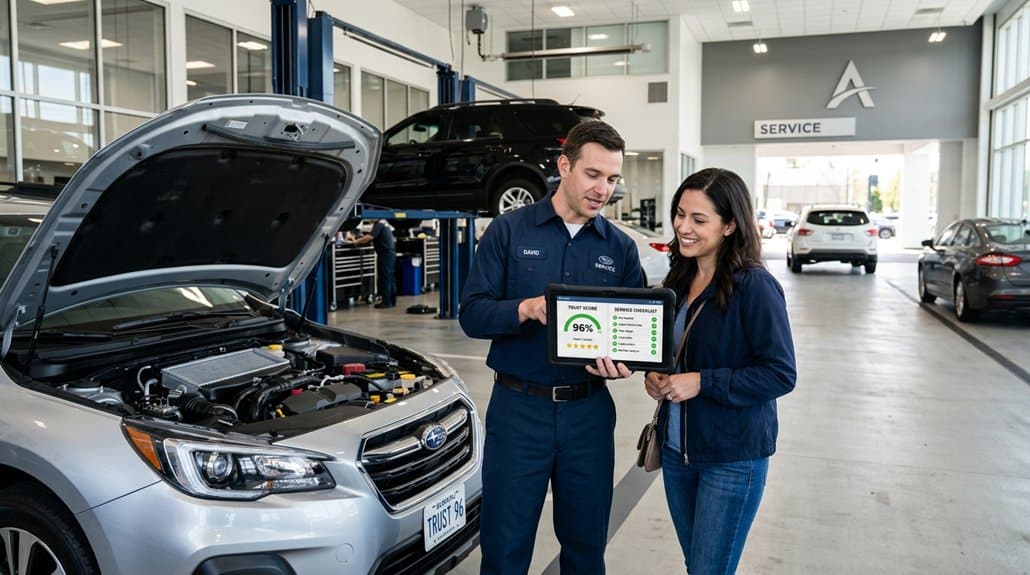
Start by tracking a Customer Confidence Score from 1–10 so you can quantify trust and set a clear benchmark for improvement. When scores fall below a 9, use targeted follow-up questions to uncover specific issues and take corrective action that recovers the relationship. Compare trends across teams and time to prioritize fixes, measure impact, and push scores toward consistent 9–10 performance.
Trust Scoring Explained
Because customers’ perceptions drive repeat visits, the Customer Confidence Score gives you a clear, data-driven way to measure trust on a 1–10 scale—where 9–10 signals strong trust and anything lower flags a risk of defection. You’ll use trust perception and score interpretation to prioritize outreach, compare teams, and track trends over time. This metric is more predictive of retention than satisfaction alone, and consistent positive experiences lift scores—86% of customers report increased trust after a great visit.
- Score meaning: 9–10 = strong trust; 1–8 = potential concern.
- Trend analysis: track score shifts by cohort and service type.
- Benchmarking: compare locations, managers, and technicians.
- Diagnostic follow-up: low scores reveal specific trust gaps.
Use the score as a strategic, customer-focused signal for improvement.
Actionable Follow‑Up Steps
Use the Customer Confidence Score to drive specific, time‑bound follow‑up actions: when a customer rates you below a 9, trigger a brief diagnostic outreach within 24–48 hours to ask targeted questions, recover the relationship, and log the root cause so you can fix systemic problems. You’ll prioritize cases by severity and segment—high-value customers and recurring issues get escalated faster. Capture customer feedback with structured prompts that map to your trust metrics, so every response becomes analyzable data. Assign owners to resolve issues and confirm remediation with the customer, closing the loop. Track response times, recovery rates, and subsequent score changes to measure effectiveness. Over time, this disciplined, data-driven follow-up turns negative experiences into opportunities to rebuild trust.
Benchmarking For Improvement
When you consistently benchmark Customer Confidence Scores across teams, channels, and time periods, you create a clear, data-driven picture of where trust is growing or eroding and which processes need attention. Use the Customer Confidence Score (1–10) to spot trust gaps—scores below 9 flag issues that impact retention more than satisfaction. Apply benchmarking techniques to compare service lanes, techs, and campaigns, and tie findings to concrete improvement strategies. Regular measurement is critical: 86% of customers report higher trust after a great experience. Follow-up questions on low scores reveal root causes and foster accountability, letting you prioritize fixes that boost loyalty.
- Track score distributions by team and channel
- Monitor trends over weekly/monthly periods
- Deploy targeted follow-up surveys on low scores
- Implement and measure corrective actions
Follow‑Up That Builds Trust (Timely & Transparent)
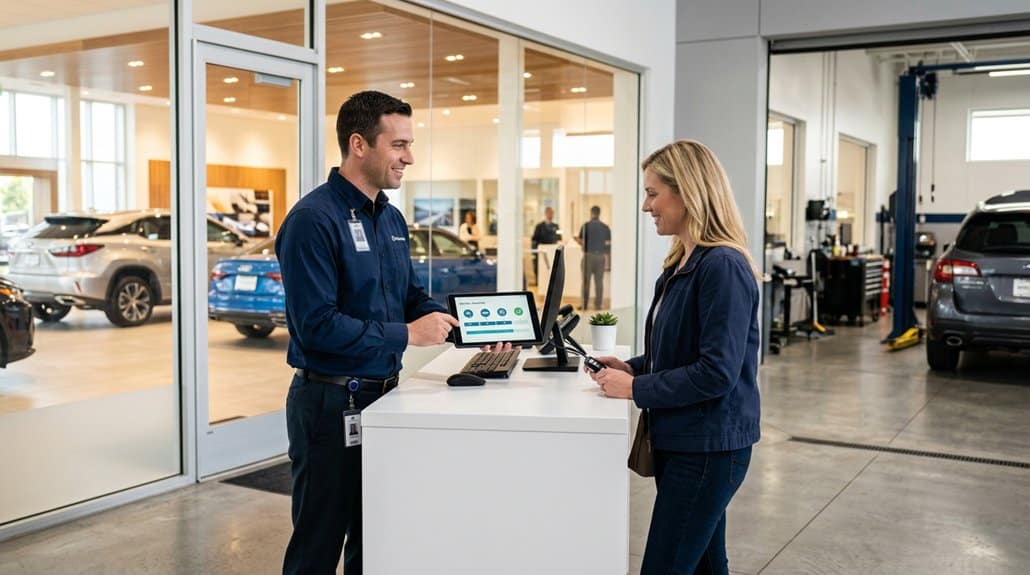
If you follow up promptly and transparently after a service visit, you’ll convert routine check-ins into trust-building moments backed by data: use customer feedback and trust metrics to prioritize outreach. You’ll act on the fact that 86% of customers report increased trust after a positive experience by confirming satisfaction quickly and documenting responses. When Customer Confidence Scores dip, ask targeted follow-up questions to uncover issues and offer corrective action. Consistent status updates during service signal respect for customers’ time and reinforce reliability. Urgent responses to negative feedback show accountability and create recovery opportunities. Adopt a structured five-step review-handling process—acknowledge, investigate, respond, resolve, follow up—to turn complaints into renewed loyalty and measurable trust gains.
Use Data & Predictive Marketing to Personalize Service Outreach
You can use predictive service segmentation to group customers by likely needs and timing, so your outreach matches what they actually need next. Automating personalized messages—based on demographics, service history, and prediction scores—keeps communications timely and relevant without added manual work. That data-driven approach helps you prioritize high-value prospects, boost service retention, and track service-to-sales conversions.
Predictive Service Segmentation
Because your service outreach is only as good as the data behind it, predictive service segmentation turns past sales and behavior into timely, personalized contact that drives engagement and revenue. You’ll use historical sales and customer behavior to spot owners nearing service milestones and prioritize outreach that feels relevant, not random. AI-driven scores rank prospects so your team focuses where conversion odds are highest. The result: higher service-to-sales conversions, improved satisfaction, and deeper loyalty as interactions become reliably useful.
- Identify customers near service milestones via purchase and maintenance history.
- Rank prospects with AI analytics for focused outreach.
- Tailor offers to known preferences to boost engagement.
- Track outcomes to refine segmentation and lift lifetime value.
Personalized Outreach Automation
When dealerships tap AI-driven analytics to automate personalized outreach, they’ll send service reminders and offers that match each customer’s vehicle history, preferences, and upcoming needs—so communications feel timely, relevant, and trusted. You can leverage predictive marketing to flag customers nearing major milestones—mileage, age, or service cadence—and trigger tailored messages that increase customer engagement and trust. Segmenting by vehicle profile helps you prioritize high-value outreach and reduce irrelevant contacts, a clear automation benefits payoff. Automated follow-ups for appointments and post-service check-ins streamline operations while signaling care and transparency. Given that 86% of customers trust brands more after tailored communication, this data-driven approach not only boosts satisfaction but also drives repeat business and strengthens long-term dealer-customer relationships.
Align Service and Sales: Convert Service‑Drive Trust Into Sales
If service visits are handled as full-funnel opportunities, they’ll become one of your dealership’s most reliable sources of sales, since service-loyal customers are more than twice as likely to buy their next vehicle from you. You should create service synergy through sales collaboration: align data, train advisors for lead identification, and map the customer journey so trust transfer is seamless. Use incentive programs to reward relationship building and guarantee only 33% isn’t the norm.
- Share service data with sales to flag trade-in timing and upsell potential.
- Train advisors on engagement strategies and scripted discovery for prospects.
- Implement incentives that track and reward qualified lead handoffs.
- Monitor conversion metrics to refine processes and improve loyalty-to-sale rates.
This converts trust into measurable revenue.
Diagnose Recurring Complaints: Root‑Cause Steps for Service Teams
Moving from converting service visits into sales, you’ll also need to tackle recurring complaints head-on to protect that hard-won trust. Start with rigorous complaint analysis: map incidents, timestamps, technicians, and parts to reveal systemic patterns rather than one-offs. Couple that with consistent feedback systems—post-service surveys, call-backs, and digital forms—to capture customer pain points immediately. Use the data to prioritize high-impact fixes, then design clear, actionable remedies and communicate them to affected customers to show accountability. Implement a structured follow-up workflow so issues are resolved and recovery is tracked. Finally, loop insights back into training, parts sourcing, and process redesign so you reduce repeat failures and steadily improve the service experience, reinforcing loyalty through measurable improvement.
KPIs & Testing Plan: Track Consistency, Retention, and S2S Lift
Because trust and consistency are measurable, you should build a compact KPI and testing plan that ties Customer Confidence Scores, retention rates, repeat-service behavior, and S2S conversion into a single dashboard—so you can quickly spot drops in trust (scores below 9), test targeted fixes, and quantify how service interactions drive sales. Use KPI Development to define thresholds, data sources, and ownership. Pair that with Testing Strategies that run controlled experiments on communication, follow-ups, and service workflows. Monitor feedback and follow-up response rates to close loops and lift scores.
Build a compact KPI and testing plan tying confidence scores, retention, repeat behavior, and S2S conversion to action.
- Customer Confidence Score (goal: 9–10) and response trends.
- Retention rate and repeat-service cadence.
- S2S conversion and revenue per retained customer.
- A/B tests on messaging, timing, and process changes.
Frequently Asked Questions
How Do You Train Technicians to Communicate Trustworthiness Consistently?
You train them with clear communication strategies, role-play, and data-driven technician training modules, so they’ll use customer-focused scripts, empathy metrics, feedback loops, and coaching to consistently demonstrate competence, transparency, and reliability in every service interaction.
What Legal/Privacy Concerns Arise From Personalized Service Marketing?
You’ll face data privacy risks, needing clear customer consent, strict transparency practices, and ethical marketing boundaries; you’ll implement secure data handling, minimize collection, audit analytics, and document permissions to stay compliant and maintain customer trust.
How Do You Handle Trust Recovery After a Major Service Error?
You act like you’ve caused a small apocalypse: immediately own the mistake, execute swift error resolution, solicit customer feedback, offer clear remediation and measurable fixes, track data to prevent recurrence, and communicate progress to rebuild trust confidently.
What Budget Allocation Is Typical for Service‑Drive Marketing Programs?
You’ll typically allocate 5–12% of service revenue; use a budget breakdown emphasizing digital ads, retention programs, and local outreach. Your marketing strategies should be strategic, customer-focused and data-driven, shifting spend by ROI and lifetime value.
How Do Third‑Party Review Sites Impact Dealership Service Trust?
Like a storefront window, third‑party review sites shape customer perception instantly; you’ll use review management to monitor ratings, respond promptly, and leverage data to boost credibility, increase retention, and drive measurable service growth.
Conclusion
Trust in your service drive is your dealership’s currency—like a lighthouse guiding repeat business through fog. Keep interactions consistent, transparent, and measured with a Customer Confidence Score so you can act on real signals, not instinct. Use timely, personalized outreach and align service with sales to turn satisfaction into measurable S2S lift. Diagnose recurring issues, test KPIs, and iterate: that data-driven, customer-focused approach builds loyalty and long-term revenue.