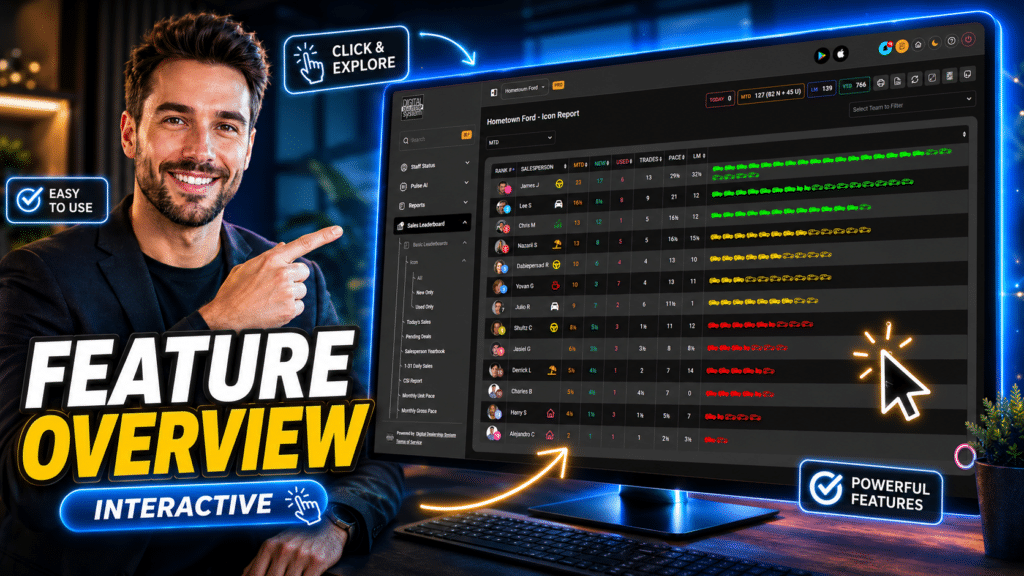

You’ll boost motivation and accountability fast by displaying real-time KPIs—quota attainment, gross margin, closing ratios, CSI, and lead sources—so reps see where they stand and managers act quickly. Instant visibility enables targeted coaching, rapid corrective moves, and gamified recognition that can lift engagement and productivity dramatically. Integrate the leaderboard with your CRM/DMS for accurate, low-latency feeds and automated scoring, then iterate rules and rewards quarterly to sustain gains—keep going to learn implementation and coaching tactics.
Key Takeaways
- Provide instant visibility into individual and team KPIs, driving accountability and daily performance focus.
- Turn progress into gamified competition, increasing engagement and motivation through real-time recognition.
- Highlight winning behaviors (high closing ratios, profitable deals) so managers can reinforce effective practices.
- Enable rapid, data-driven coaching by surfacing recent trends and specific improvement opportunities.
- Align rewards and targets to measurable metrics, incentivizing prospecting, follow-ups, and margin-focused selling.
Why Real-Time Leaderboards Fix Motivation And Transparency Problems

Because visibility drives behavior, real-time sales leaderboards give you instant access to individual and team KPIs—sales, targets, and customer-service scores—so accountability is clear and measurable. You’ll leverage transparency benefits to pinpoint gaps immediately, enabling targeted coaching and rapid corrective action. By presenting ranked metrics and live feedback, leaderboards apply proven motivation techniques: gamification increases engagement and can boost productivity by roughly 50%, while public progress signals drive healthy competition. That competitiveness, paired with swift manager intervention, reduces lag in performance improvements and aligns daily activity with strategic revenue goals. Organizations using real-time leaderboards report up to a 45% increase in sales margins, showing this approach delivers measurable ROI on both behavior and bottom-line performance.
KPIs To Track On Your Real-Time Dealership Leaderboard
When you build a real-time dealership leaderboard, focus on a concise set of KPIs that directly drive revenue and customer retention: sales targets and gross revenue to measure output and margin, closing ratio to assess sales effectiveness, CSI scores to track service quality, and BDC lead-source conversion to pinpoint where high-value prospects come from. You’ll use these accountability metrics to increase performance visibility, shape team dynamics, and enable motivation strategies tied to competition elements.
| KPI | Purpose | Action |
|---|---|---|
| Sales Targets | Track quota attainment | Adjust focus weekly |
| Gross Revenue | Measure margin impact | Prioritize profitable deals |
| Closing Ratios | Assess effectiveness | Coach weak steps |
| Lead Sources | Identify high-value origin | Reallocate BDC effort |
Those KPIs give crisp, data-driven signals for tactical coaching and competitive engagement.
Design Rules And Rewards To Drive Desired Sales Behaviors

Although clear rules are simple, they’re powerful: define eligibility, scoring windows, tie-breakers and reset periods so everyone knows exactly what behavior earns recognition and why. You’ll pair that clarity with measurable behavior incentives—include KPIs that reward prospecting, follow-ups and skill-building actions to shift activity, not just closings. Use reward customization so incentives align with individual motivators: tangible prizes for reward-chasers, public recognition for socializers, and competitive rankings for fun-seekers. Balance top-performer awards with progress-based rewards to keep mid-tier reps engaged and reduce churn. Collect regular feedback and track participation, conversion lift and retention to validate impact. Iterate rules quarterly, using data to remove gaming opportunities and sharpen the link between actions and outcomes.
Pick And Integrate A Real-Time Leaderboard Tool With Your CRM/DMS
If you want real-time visibility that actually changes behavior, pick a leaderboard tool that natively syncs with your CRM/DMS and pushes live KPI updates to reps and managers; that single decision reduces manual entry, surfaces performance gaps immediately, and makes coaching timely and evidence-based. For leaderboard selection, prioritize native connectors, low-latency feeds, and configurable KPIs so individual and team metrics display prominently. Integration challenges often stem from data mappings, authentication, and mismatch in update cadence—mitigate these with an integration plan, API testing, and clear ownership. Automated syncing cuts manual workload, delivers accurate, motivating metrics, and supports gamification proven to lift motivation ~72% and engagement ~60%. Choose a partner experienced in dealership CRMs/DMSs to streamline deployment and accountability.
Use Leaderboard Data To Coach, Iterate, And Sustain Results

Because real-time leaderboards surface performance gaps the moment they occur, you can coach with evidence instead of intuition—pulling up a rep’s recent KPIs, pinpointing where conversion or follow-up falls off, and assigning targeted actions that are tracked on the same dashboard. You’ll use leaderboard data to define coaching strategies, iterate quickly on training content, and monitor performance trends to sustain results. Continuous leaderboard visibility creates accountability, lets you celebrate small wins, and reinforces behaviors that lift conversion rates. Tailored coaching plans address specific metrics, and recurring snapshots show whether iterations work. Use the table below to structure short-cycle coaching sprints and measurable outcomes.
| Focus | Metric |
|---|---|
| Sprint goal | Conversion % |
| Action | Follow-up touches |
| Outcome | Delta in rank |
Frequently Asked Questions
How to Increase Sales Team Motivation?
Use real-time leaderboards, team incentives, and performance recognition to drive accountability; set clear KPIs, update standings frequently, offer personalized rewards, and track results—this strategic, data-driven approach boosts motivation, productivity, and measurable sales outcomes.
How Can Sales Managers Motivate and Lead Sales Team to Achieve Sales Target?
You’ll set clear targets, use performance incentives tied to real-time metrics, foster team collaboration with shared goals and recognition, provide continuous feedback, and personalize rewards—driving accountability, engagement, and measurable productivity gains.
Which Factors Motivate You When Leading a Sales Team?
You’re motivated by clear incentive structures, timely performance recognition, measurable targets, real-time feedback, and transparent metrics; you’ll prioritize data-driven coaching, strategic resource allocation, and tailored rewards to drive accountability, engagement, and consistent sales growth.
How Do Sales Leaders Train, Motivate, and Manage Their Teams?
You train, motivate, and manage teams by obsessively tracking team dynamics and delivering rapid performance feedback, using data-driven targets, targeted coaching, gamified recognition, regular check-ins, and tailored development plans that boost accountability and measurable results.
Conclusion
Think of your leaderboard like a race-day scoreboard: when one rep closed three deals in a week, their climb sparked a 24% team uplift the next month. You’ll keep motivation honest and measurable by tracking the right KPIs, wiring the board into your CRM/DMS, and tying rewards to behaviors. Use those real-time signals to coach fast, iterate often, and sustain gains—because visible progress breeds repeatable performance.