
Three recent automotive reports tell different stories about dealership performance, but they point toward the same conclusion: technology only creates value when it makes the experience clearer for employees and customers.
The latest data from the National Automobile Dealers Association shows fixed operations becoming even more important to dealership performance. CDK Global’s research highlights the operational friction created when employees must move between disconnected systems. Pied Piper’s latest service-scheduling study shows that dealerships are improving, yet customers are still being lost during basic website, telephone and AI-to-human handoffs.
From the perspective of Digital Dealership System, the common thread is not a lack of technology. It is a lack of consistent visibility across the dealership.
Fixed Operations Is Growing—But Every Opportunity Matters
The NADA Data 2026 Midyear Report found that franchised dealerships generated nearly $83 billion in service and parts sales during the first half of 2026. Fixed-operations revenue increased 2.2% even though the number of repair orders declined slightly.
That is encouraging, but it also raises the value of every customer interaction. When repair-order volume is not growing at the same rate as revenue, dealerships cannot afford unnecessary confusion, missed recommendations or inconsistent communication.
Customers should understand where their vehicle is in the service process, what has been recommended and what happens next. Advisors and technicians should be able to see the priorities that matter during the day—not discover them after the opportunity has passed.
Fixed operations is not only a revenue center. It is one of the dealership’s most important customer-retention channels, and the experience surrounding the repair matters just as much as the work itself.
More Software Does Not Automatically Create a Better Process
In its September analysis, CDK Global reported that 72% of dealership F&I offices use four or more software solutions to complete a deal.
Each system may serve a legitimate purpose. The problem appears when employees must repeatedly switch platforms, verify transferred information or rebuild parts of a deal because the systems do not work together as expected. Those interruptions consume time and can create visible frustration for the customer.
This is not an argument against dealership technology. It is an argument for evaluating technology based on the experience it creates.
A successful dealership technology strategy should make the next action easier to understand. It should reduce ambiguity, support the employee handling the customer and keep important information visible at the moment it is needed.
Technology should fit into the dealership’s operating rhythm. The dealership should not have to reorganize its people around the limitations of its technology.
Service Appointments Are Still Being Lost in the Handoff
The 2026 Pied Piper Service Scheduling Effectiveness Study found that the automotive industry improved its overall service-scheduling performance. Website scheduling improved particularly well, with fewer technical failures and better appointment availability.
However, the study also found that 16% of customers calling dealerships were unable to schedule an appointment. Approximately one-third of attempted AI-to-human transfers failed, resulting in voicemail, disconnection or extended holds.
The lesson is not that dealerships should avoid AI or automation. Routine scheduling can become faster and more convenient when those tools work correctly. The lesson is that the entire handoff must be designed and measured—not only the first automated interaction.
Customers do not separate the AI assistant, website scheduler, service advisor and dealership management system into individual experiences. To the customer, it is all one dealership. If any part of that journey fails, the dealership owns the result.
Digital Dealership System’s Perspective: Visibility Connects the Experience
Dealerships already collect enormous amounts of information. The greater challenge is placing the right information in front of the right person at the right time.
For customers, that may mean a clearly presented service status, an understandable menu, timely dealership information or relevant service education displayed where they naturally look.
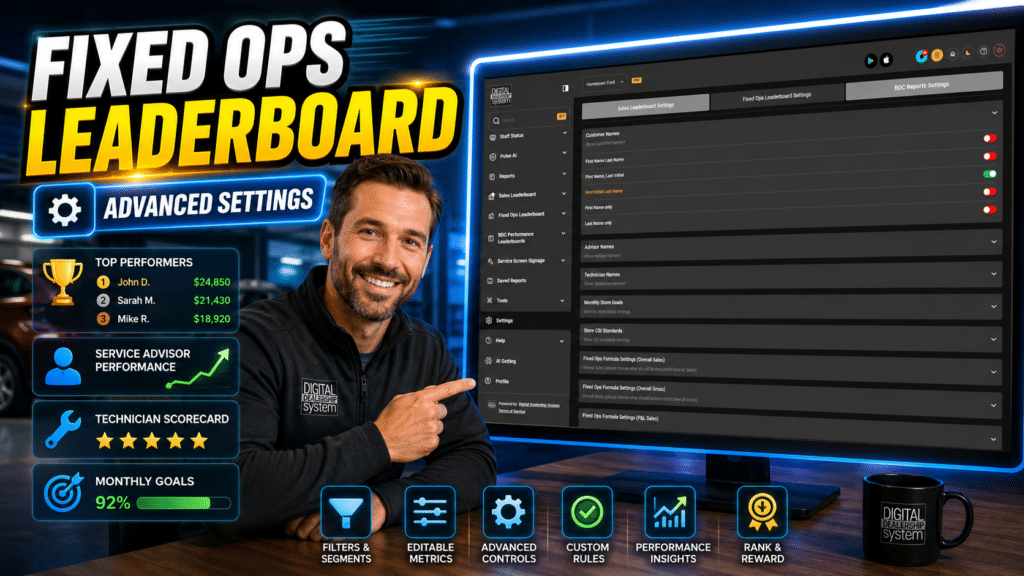
For frontline employees, it may mean visible daily goals, current performance, recognized accomplishments and clear priorities across sales, BDC and fixed operations. A staff-facing leaderboard should not replace leadership; it should give managers a stronger foundation for coaching, recognition and accountability.
The distinction matters. Customer-facing screens should reduce uncertainty and improve communication. Staff-facing performance screens should create focus and make progress visible. Trying to make one screen serve every audience usually weakens its usefulness for everyone.
Digital Dealership System believes dealership technology should support human performance rather than compete with it. The best tools make it easier for employees to do the right thing, for managers to lead effectively and for customers to understand what is happening.
Four Questions Dealership Leaders Should Be Asking
As dealerships evaluate their technology and communication processes, these questions are worth considering:
- Can customers easily understand what happens next?
- Can frontline employees see the priorities they are expected to influence today?
- Do departmental handoffs preserve information and momentum?
- Is each technology improving the experience—or simply adding another place to look?
The answers will reveal more than the number of platforms a dealership owns. They will show whether those platforms are working together to support the business.
Better Visibility Creates Better Execution
The newest industry research does not suggest that dealerships need another disconnected tool. It suggests that dealerships need clearer experiences, stronger handoffs and technology that supports the people responsible for delivering results.
Digital Dealership System helps dealerships bring important customer communication and frontline performance information into view through purpose-built, DMS-connected digital signage and performance leaderboards.
Explore Digital Dealership System solutions or schedule a demonstration to see how better visibility can support a more consistent dealership experience.
Sources
NADA Data 2026: Midyear Report
CDK Global: 3 Ways Streamlining F&I Processes Boost Your Bottom Line
Pied Piper: 2026 Auto Industry Service Scheduling Effectiveness Study