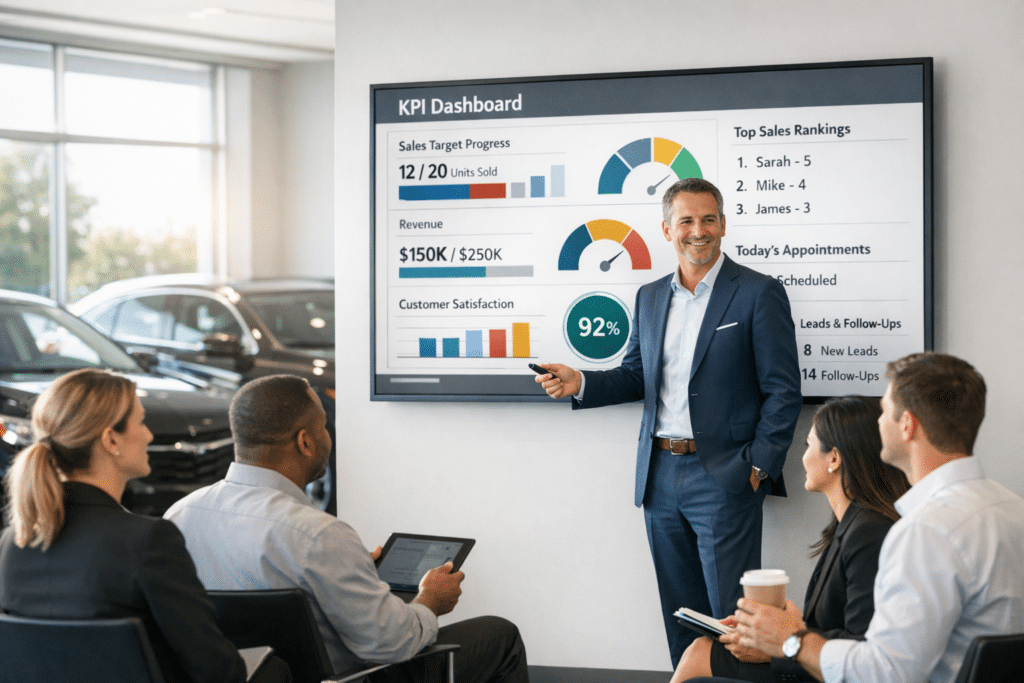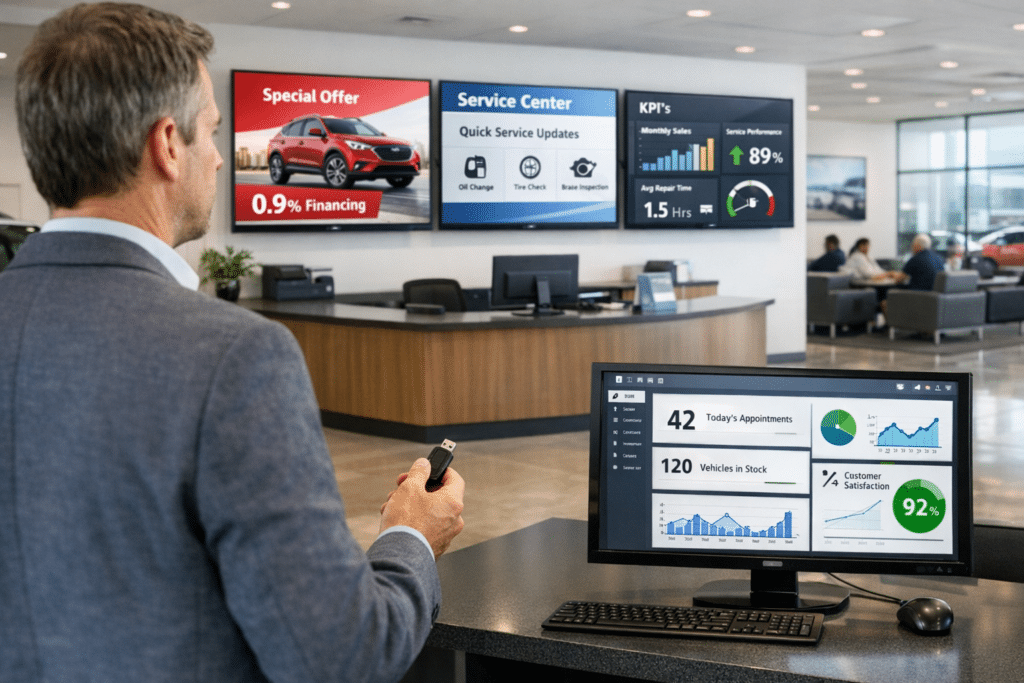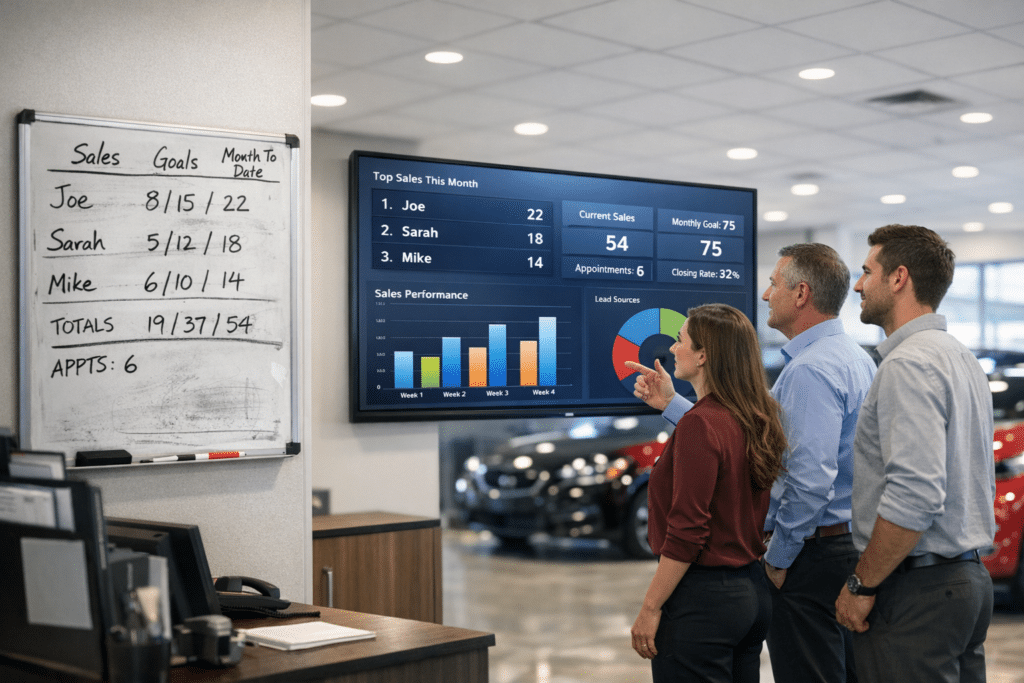

You’ll turn your DMS into a real‑time engine of daily motivation by surfacing units, gross profit, conversion and follow‑up metrics in ranked leaderboards that drive accountability and coaching. Instant visibility removes manual errors and highlights top performers and reps who need help. Customizable goals, points and sprint challenges align daily activity with business targets while measurable KPIs prove ROI. Integrate visuals into huddles and routines for sustained momentum, and keep going to learn practical setup and scaling tips.
Key Takeaways
- Display real-time dealer metrics (units, GP, conversion) to create immediate, actionable visibility for sales teams.
- Rank performers and show progress bars to drive accountability and healthy competition.
- Tie clear, measurable targets to points, badges, and tiered rewards to reinforce desired behaviors.
- Integrate leaderboards into daily huddles and routines to translate data into short-term goals and coaching moments.
- Customize dashboards by location and role so teams see relevant KPIs and can replicate top-performer tactics.
What a DMS Sales Leaderboard Does (Quick Benefits)

A DMS sales leaderboard gives you real-time visibility into individual and team performance, so you can spot winners, gaps, and trends the moment they happen. You’ll use performance tracking to monitor metrics that matter—sales per rep, conversion rates, and time-to-close—so decisions are evidence-based. This visibility boosts accountability by displaying rankings and progress, which supports motivation strategies that target weaker cohorts and reward top performers. Integration with your DMS guarantees data is current and accurate, removing manual-entry errors that skew strategy. Customizable metrics let you align dashboards with business goals, driving targeted improvements in activity and outcomes. With desktop and mobile access, your team can stay engaged and focused on daily objectives.
Connect Your DMS to Power Real‑Time Leaderboards
When you connect your DMS to real‑time leaderboards, you get instant, reliable visibility into each rep’s performance across desktop and mobile so teams stay motivated and managers can act on accurate data. You’ll see DMS integration benefits immediately: Real time updates remove manual errors and keep leaderboard data trustworthy for Performance tracking and strategic coaching. Leaderboard customization lets you align displays with business goals and surface the signals you care about. The system drives accountability and quick corrective action, while making performance visible to everyone. Consider using the leaderboards to:
Connect your DMS to real-time leaderboards for instant, accurate visibility—fueling motivation, accountability, and targeted coaching across devices.
- Highlight top performers for recognition.
- Flag reps needing targeted coaching.
- Adjust goals or contests based on current trends and outcomes.
Which Leaderboard Metrics Move the Needle (Units, GP, Conversion)
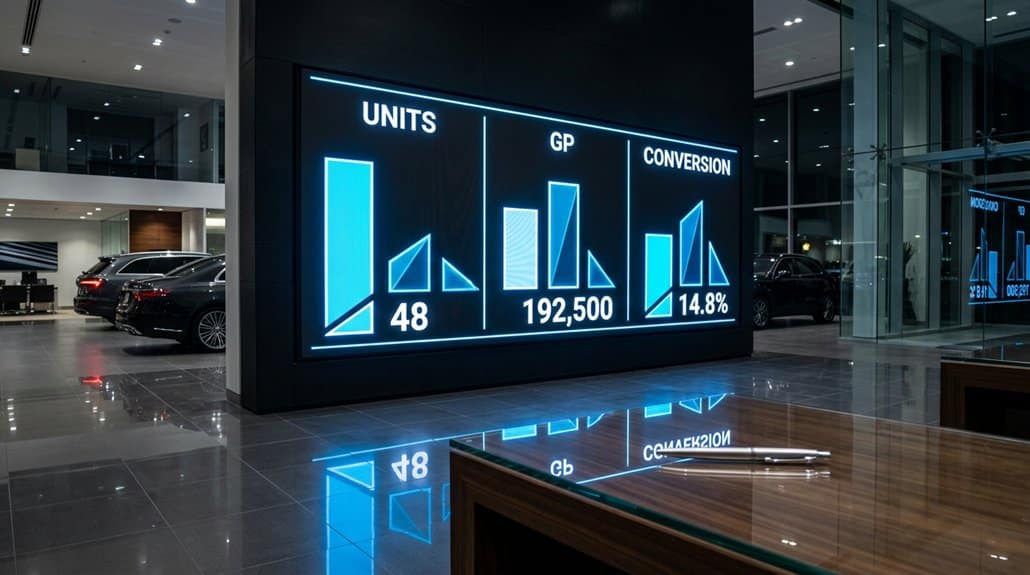
Why focus on units, gross profit (GP), and conversion on your leaderboards? Because tracking units sold, gross profit, and conversion rates gives you data insights that directly inform sales strategies and performance benchmarks. You’ll spot who’s driving volume, who’s protecting margin, and where leads slip through. Real-time visibility fuels daily accountability and a competitive spirit—team members adjust tactics the same day they see gaps. Use customizable settings to prioritize the metric that aligns with your goals: ramping units sold to grow market share, optimizing gross profit to boost net results, or improving conversion rates to get more value from existing leads. These targeted metrics let you turn raw DMS data into measurable, strategic action.
Design Visuals That Boost Leaderboard Visibility and Engagement
You’ll increase leaderboard visibility by using bold, high-contrast colors that prioritize key KPIs for quick scanning across desktop and mobile. Pair that with dynamic, readable typography sized for distance and speed-readers to guarantee metrics and rankings are immediately clear. This strategic combination boosts engagement and recognition, which data show improves motivation and performance when tailored to dealership needs.
Bold, High-Contrast Colors
Although subtle design tweaks can help, bold, high-contrast colors are a proven way to boost leaderboard visibility and engagement: they make metrics legible from across the showroom, improve information retention (studies report gains up to 78%), and let your team instantly read rankings and act on gaps. You’ll use color psychology and clear visual hierarchy to prioritize calls-to-action, highlight top performers, and surface opportunities. High-contrast palettes cut eye strain in bright environments and keep staff focused on updates. Color-coded rankings create immediate motivation and support brand alignment through customizable schemes. Apply these tactical guidelines:
- Use a limited palette to separate tiers and avoid visual clutter.
- Reserve accent colors for alerts and top-performer highlights.
- Test contrast ratios for readability at distance and under showroom lighting.
Dynamic, Readable Typography
Bold color schemes get attention, but typography determines whether that attention actually converts into comprehension and action. You’ll leverage typography trends and readability strategies to make leaderboard metrics instantly scannable across devices. Dynamic typography — adjustable font sizes, weight hierarchy, and responsive scaling — guarantees key KPIs pop on both desktop and mobile, increasing quick comprehension. Pair bold, contrasting color cues with clear type hierarchy so rankings and targets draw the eye and prompt behavior change. Add subtle animations or shifts for updates to sustain engagement without sacrificing legibility. Data shows readable presentations boost engagement; you’ll let customers customize styles to match workflow and visibility needs, turning raw DMS data into timely, motivating insights that drive performance.
Set Goals and Gamify How Your Team Wins

You’ll set clear, measurable targets tied to specific KPIs so every team member can see how points translate into business impact. Use badges, tiered rewards, and time-bound leaderboard challenges to reinforce behaviors that increase units sold and gross profit. Track results with real-time analytics to iterate on incentives and keep customer-focused goals aligned with your sales strategy.
Clear, Measurable Targets
When you set clear, measurable targets on a DMS sales leaderboard, every rep can see exactly what success looks like and how close they are to it in real time. You’ll use target setting and performance tracking to convert raw dealership data into daily priorities, aligning individual goals with gross profit and unit objectives. Public rankings and customizable metrics create accountability and sharpen focus without micromanaging. Advanced analytics let you adjust targets dynamically so goals stay challenging yet attainable, preserving motivation. Use the leaderboard to reinforce behaviors that drive customer satisfaction and conversion rates.
- Define specific, time-bound sales and profit targets.
- Update metrics continuously for real-time visibility.
- Review and recalibrate goals based on analytics.
Points, Badges, Rewards
Start with a clear points system tied to measurable behaviors—assign values for closed deals, upsells, customer satisfaction scores and timely follow-ups—so reps know exactly what actions move their rank and why it matters to dealership profit. You’ll map performance metrics to point values, then apply gamification strategies that convert daily activity into visible progress. Use badge recognition for milestones like Top Seller or Most Improved to drive morale and publicize success. Implement reward tiers where crossing thresholds activates bonuses, promoting sustained effort. Combine engagement techniques with team collaboration features so peers coach toward shared targets rather than just compete. This data-driven, customer-focused approach creates a healthy competitive atmosphere while aligning incentives to revenue, retention and measurable service outcomes.
Leaderboard-Based Challenges
A clear set of leaderboard-based challenges turns everyday sales activities into measurable sprints, so your team knows exactly which targets matter and how to climb the ranks. You’ll use DMS analytics to set focused challenges—units sold, profit per deal, or customer-satisfaction improvements—so every metric ties to dealership goals and customer outcomes. Weekly and monthly mini-sprints sharpen team dynamics and sustain competitive spirit, with real-time ranking updates that drive rapid behavior change. Structured incentives reward progress and accountability while reinforcing teamwork. Use short, focused challenges to maximize engagement:
- Weekly units-sold sprint to push throughput.
- Biweekly profit-margin focus to protect ROI.
- Monthly CSI push to improve retention.
This approach is measurable, scalable, and customer-centered.
Train Your Team to Use the Leaderboard Daily
Make checking the DMS Sales Leaderboard part of your team’s daily routine so everyone sees real-time rankings and metrics that drive short-term focus and long-term growth. You’ll use leaderboard training to teach staff how to interpret customized metrics tied to daily sales goals, so data becomes actionable for each role. Schedule brief daily engagement huddles to review standings, reinforce priorities, and surface coaching opportunities backed by the numbers. Train reps on personalization features so they track the KPIs that matter to their customers and territory. Celebrate daily or weekly wins shown on the board to sustain motivation and model best practices. Consistent use turns leaderboard insights into measurable behavior change, improving conversion rates and customer outcomes over time.
KPIs to Prove Your DMS Leaderboard ROI
Because you need clear evidence that the leaderboard moves the needle, focus on KPIs that tie directly to revenue, efficiency, and engagement—units sold, gross profit per unit, conversion rate, days-to-sale, and follow-up-to-purchase ratio—so you can quantify the leaderboard’s impact on sales productivity, inventory turnover, and staff motivation. Use real-time DMS data to set KPI benchmarks and refine Sales forecasting models; you’ll see productivity climb toward that 20% uplift and revenue toward the 15% target. Track engagement metrics to validate the 25% motivation gain and coach for the 30% accountability improvement. Prioritize three core actions:
- Monitor units sold and gross profit per unit daily.
- Compare conversion rate and days-to-sale against benchmarks.
- Integrate leaderboard trends into Sales forecasting and inventory planning.
Common Rollout Problems and How to Fix Them
While a leaderboard can boost sales, rollouts often stumble on technical, cultural, and design fronts, so you should plan fixes up front. You’ll face integration challenges—mitigate them by choosing a compatible DMS, involving IT during setup, and validating data flows with test cases. Staff resistance is common; reduce it with targeted training, clear demonstrations of real-time value, and early adopter champions who model usage. Define metrics tied to your sales objectives to avoid confusion, and customize views so teams see only relevant KPIs. Invest in high-contrast, accessible displays to sustain engagement. Finally, implement structured feedback loops and regular check-ins to monitor adoption, iterate on problems quickly, and measure impact so leadership can justify continued investment.
Scale Your DMS Leaderboard Across Multiple Locations
When you scale leaderboards across locations, you get clear, real-time visibility into multi-store performance so you can spot trends and outliers quickly. Centralized goal management lets you set consistent targets and push tailored goals to each site while keeping enterprise-level oversight. Use the data to replicate top-performing tactics and close gaps across your network.
Multi-Store Performance Visibility
Think of multi-store leaderboards as a single pane of glass that puts real-time sales performance for every location at your fingertips, so you can compare metrics, spot trends, and allocate resources with precision. You’ll get multi store collaboration and data driven insights that reveal which stores lead in units, conversion, and gross per vehicle. The Enterprise version consolidates feeds so managers can quickly diagnose issues and celebrate wins across the network.
- Standardize key metrics for clear cross-store comparison.
- Surface real-time alerts to address dips or seize momentum.
- Customize views per location to deliver relevant coaching.
This visibility fosters accountability, fuels healthy competition, and lets you make strategic, resource-allocation decisions informed by timely, actionable data.
Centralized Goal Management
One platform puts every location’s targets and progress in one place, so you can set, compare, and adjust goals across your dealer network with clarity and speed. With centralized tracking, you aggregate real-time sales data from multiple dealerships to identify trends, flag top performers, and replicate winning behaviors. You’ll tailor metrics per site—units, gross, F&I penetration—so goals reflect local market realities while remaining comparable network-wide. Visible leaderboards drive performance accountability by showing where coaching or incentives will move the needle. That transparency keeps teams engaged daily, accelerates corrective actions, and reduces lag in decision-making. Ultimately, centralized goal management turns dispersed data into actionable insights, improving efficiency, profitability, and consistent execution across all your locations.
Daily Routines and Automation to Keep Momentum Going
Because momentum depends on visibility and consistency, integrating DMS Sales Leaderboards into daily routines guarantees you’re seeing real-time progress and acting on it instantly. You’ll use daily engagement strategies that display specific sales goals on desktop and mobile, so each team member knows where they stand and what to improve. Automated recognition systems send instant notifications for wins, reinforcing behaviors that lift overall performance. Integration with your DMS keeps metrics current without manual updates, preserving data integrity and decision speed. To maintain momentum, follow this disciplined daily checklist:
Integrate DMS leaderboards into daily routines—real-time visibility, instant recognition, and data-driven targets to sustain momentum.
- Review real-time rankings first thing.
- Acknowledge top performers via automated alerts.
- Adjust individual targets based on live data.
This approach is strategic, customer-focused, and measurable.
Frequently Asked Questions
How Do Leaderboards Protect Sensitive Customer and Employee Data?
You protect sensitive customer and employee data by applying data encryption, enforcing strict privacy policies, role-based access, audit logs, and regular compliance checks, ensuring the leaderboard’s insights stay secure, transparent, and customer-focused while driving strategic performance.
Can Leaderboards Integrate With Payroll or Commission Systems?
Like a well-tuned clock, yes — leaderboards can integrate with payroll or commission systems. You’ll gain integration benefits, improved commission accuracy, real-time transparency, reduced disputes, and actionable analytics that drive customer-focused, strategic compensation decisions.
What Accessibility Options Exist for Visually Impaired Users?
You’ll get screen reader compatibility, keyboard navigation, and high visual contrast modes; analytics track usage and outcomes, letting you prioritize accessibility investments, measure adoption, and align leaderboards with customer-focused, strategic inclusivity goals and compliance.
How Do You Prevent Unhealthy Competition or Gaming the System?
You curb unhealthy competition by setting balanced KPIs, rotating metrics, and rewarding team collaboration. For example, one dealership cut gaming by 40% after adding team goals—so you’ll stay strategic, data-driven, and customer-focused while keeping morale healthy.
Can Leaderboards Be Customized for Fixed Operations (Service/Parts)?
Yes — you can customize leaderboards for fixed ops using custom metrics that track service efficiency, parts sales, and technician performance; you’ll get actionable, data-driven insights that boost customer satisfaction and align with strategic operational goals.
Conclusion
You’ll see your DMS sales leaderboard turn raw data into daily, actionable motivation that actually moves the needle. By connecting real‑time metrics like units, GP and conversion, designing clear visuals, and gamifying goals, you’ll create measurable momentum across locations. Fix rollout snags quickly, track KPIs to prove ROI, and automate routines so leaders get insights without lifting a finger. The impact can be as dramatic as lighting a fire under your whole sales floor.