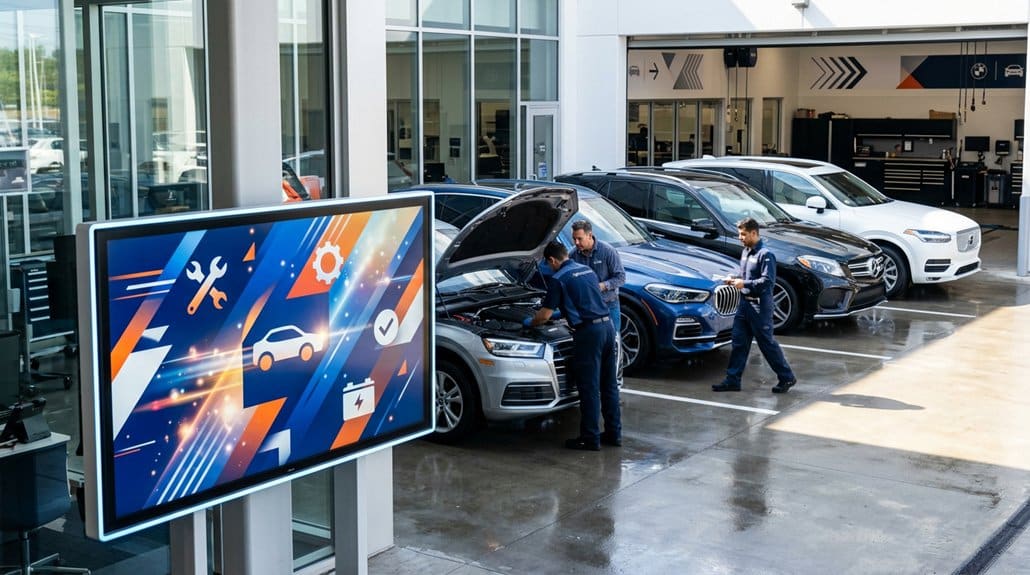
You should use service‑drive digital signs to show real‑time wait times, personalized greetings, and live service status to reduce interruptions and improve flow. Promote limited‑time service specials, bundled upsells, and next‑available slots with QR booking to drive conversions. Rotate quick maintenance tips and seasonal reminders that prompt technician bookings. Feature short, verified delivery testimonials and staff spotlights to build trust. Track dwell time, CTA taps, and conversions for optimization—keep going to see practical scheduling and KPI tactics.
Key Takeaways
- Real-time wait times, next-available slots, and booking QR codes to reduce uncertainty and speed decisions.
- Limited-time service specials and bundled offers with clear CTAs to drive immediate upsells.
- Bite-sized preventive maintenance tips (oil, tires, wipers) with prompts to schedule technician checks.
- Customer testimonials and star ratings paired with delivery visuals to build trust and credibility.
- Inventory highlights and targeted service promos (e.g., traction-control tires) with pricing cues and urgency.
What Service Drive Digital Signs Should Achieve
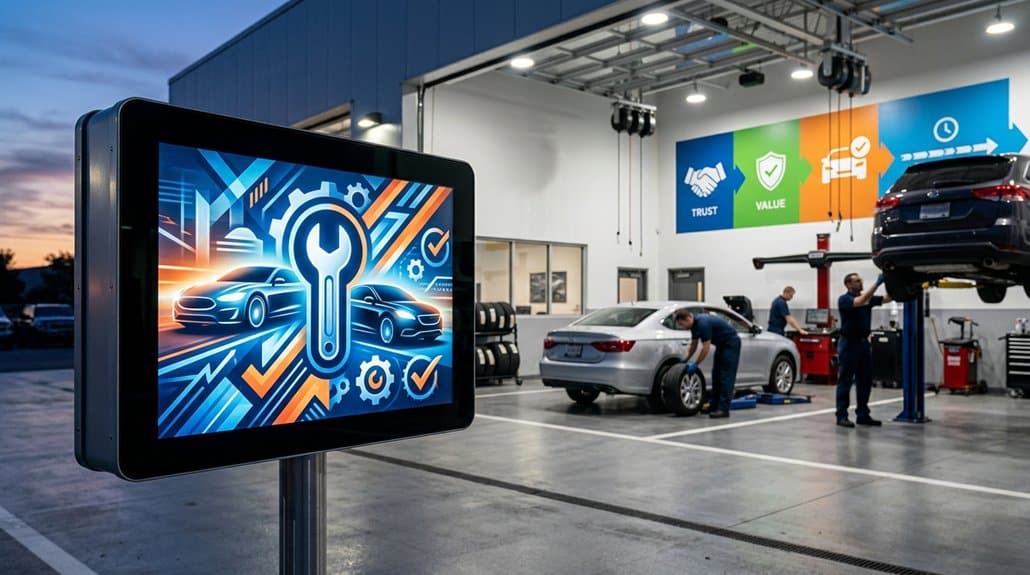
While customers wait, service drive digital signs should deliver real-time wait times and service status, clear promotions with calls-to-action, bite-sized maintenance tips, and customer testimonials—each element designed to reduce anxiety, drive bookings, encourage preventive care, and build trust. You’ll leverage these signs to increase customer engagement by presenting concise, actionable offers that prompt immediate bookings and upsells. Displayed maintenance tips drive preventive care and repeat visits, improving vehicle longevity and satisfaction while reducing costly emergency repairs. Testimonials establish credibility, shortening decision cycles for additional services. Strategically placed screens guide customers to lanes or advisors, optimizing traffic flow and service efficiency. Implement consistent measurement—clicks, scans, appointment conversions—to iterate content and quantify ROI for operations and marketing.
Personalized Greetings & Wait‑Time Updates
Because customers value being seen and informed, personalized greetings and live wait-time updates on service drive signs turn passive screens into active service tools. You can deploy customer recognition to display names, appointment times, and technician assignments, which immediately raises perceived service quality. Real-time wait-time updates provide transparency, reduce uncertainty, and cut repetitive staff interruptions, letting technicians focus on repairs. Integrating personalized messaging with dynamic timelines fosters a welcoming atmosphere that improves satisfaction and repeat business. For implementation, tie your signage to scheduling and CRM systems, set refresh intervals to reflect current queue status, and log display events for analysis. These engagement strategies are measurable: track satisfaction scores, dwell-time sentiment, and interruption frequency to validate ROI.
Promotions & Limited‑Time Service Specials
Personalized greetings and live wait-time updates prime customers for offers, and you can capitalize on that engagement by promoting limited-time service specials on your service drive signs. Use clear calls-to-action, explicit expiry dates, and countdown timers to create measurable urgency that converts viewers to booked appointments. Update displays daily in alignment with promotional calendars so content stays relevant and drives repeat visits. Bundle value—advertise service bundles like oil change plus free multi-point inspection—to increase perceived value and enable strategic upsells. Design signage to show next-available slots or QR codes for immediate booking to reduce friction. Track which promotions generate appointments and iterate offers based on conversion metrics. This disciplined, data-driven approach maximizes foot traffic, revenue per visit, and campaign ROI.
Quick, Actionable Maintenance Tips Customers Can Use Today
Start by showing customers three quick checks they can do today: a dipstick oil check to confirm level and color, a tire pressure quick‑read against the placard PSI, and a cursory wiper blade inspection for cracking or streaking. Explain the measurable benefits—preventive oil checks reduce engine wear, correct tire pressure improves fuel economy and handling, and timely wiper replacement sustains visibility in wet conditions. Prompt them to book a technician if any reading is outside spec or if blades fail the wipe test.
Quick Oil Check
When you want to avoid costly engine damage, a quick oil check takes just a few minutes and can reveal if your oil level or condition needs attention. You’ll park on level ground, pull the dipstick, wipe it, reinsert, then read against markings—confirming proper oil level is fundamental to engine maintenance. Inspect color and texture: clear amber and smooth means good; dark or gritty means change required. Use the oil grade in your owner’s manual; synthetic options usually improve protection and fuel efficiency. Regular checks every few hundred miles between service visits help catch low oil before overheating or wear occurs. This simple, repeatable procedure reduces repair risk and supports manufacturer-recommended 5,000–7,500-mile intervals.
Tire Pressure Guide
After you’ve checked the oil, give your tires the same routine attention: tire pressure affects fuel economy, handling, and safety more than most drivers realize. Check monthly with tires cold; a 1 PSI drop can cut fuel efficiency by about 3%. Use the owner’s manual or driver-door sticker for proper PSI—correct inflation benefits include longer tread life and reduced blowout risk. Visually inspect for uneven wear that signals misinflation or alignment issues. Temperature changes raise pressure ~1 PSI per 10°F, so recheck when seasons shift.
- Check tires at least once a month when cold
- Use manufacturer PSI from door sticker/manual
- Note +1 PSI per 10°F temperature rise
- Inspect tread for uneven wear
- Address under-inflation to reduce blowout risk
Wiper Replacement Reminder
Although wiper blades might seem minor, you should replace them every 6–12 months to maintain clear visibility and reduce accident risk; inspect for streaking, skipping, or cracked rubber and swap blades sooner in harsh climates. You’ll want concise wiper maintenance tips on your service-drive sign: remind drivers to check blades monthly, replace at six months in severe weather, and use washer fluid with cleaning agents to remove contaminants that accelerate wear. Emphasize that worn blades cause poor visibility and raise collision risk, so upgrading to quality blades is a cost-effective safety measure. Use seasonal wiper reminders—before winter and rainy seasons—to prompt preventive replacement. These targeted messages drive immediate service bookings and improve customer safety metrics.
Customer Testimonials & Delivery Moments That Build Trust
You’ll boost credibility by showing star ratings and short testimonial excerpts on your service drive digital signs, giving prospects quantifiable social proof at a glance. Pair those ratings with delivery moment visuals—photos or brief clips of customers receiving their vehicles—to create emotional cues that reinforce trust. Rotate verified testimonials and recent delivery images to keep content current and maximize shareability and referrals.
Star Ratings Display
1 simple element—star ratings paired with real customer testimonials—can immediately boost your service drive’s credibility and calm anxious customers. You’ll leverage star rating impact and measurable social proof to increase customer trust, reduce perceived risk, and shorten sales cycles. Implement verified, rotating testimonials to keep displays relevant and compliant.
- Show average star rating prominently
- Include short, attributed testimonial lines
- Rotate entries on a timed schedule
- Verify reviews before display
- Link to full reviews via QR
Technically, prioritize legibility, contrast, and update automation so content scales across locations. Use analytics to measure dwell time and interaction uplift from displayed reviews. This focused approach humanizes your dealership, drives conversion, and makes service waits productive trust-building opportunities.
Delivery Moment Visuals
Delivery moments—photos or short clips of customers taking delivery of their new vehicles paired with concise testimonials—create immediate emotional resonance and measurable trust signals on your service drive displays. You’ll leverage delivery impact by pairing authentic visuals with brief quotes and star ratings, reinforcing credibility—79% of consumers weight reviews like personal referrals. Rotate content to sustain novelty, boosting social interactions and referral likelihood while demonstrating consistent satisfaction metrics. Present clips at ideal length and resolution to preserve attention and load times; use templates that foreground the testimonial, rating, and vehicle model for quick scanning. This strategy builds emotional connection and community perception, converting passive viewers into engaged prospects by translating real customer enthusiasm into observable, data-backed trust cues on the lot.
Inventory Highlights & Feature Comparisons to Upsell Services
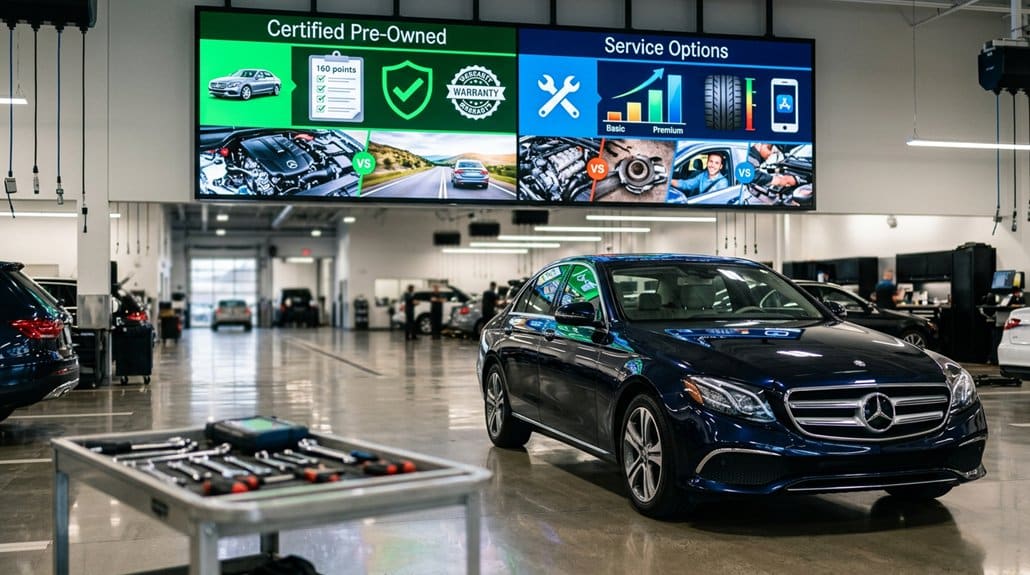
Three clear display zones — current inventory, feature highlights, and model comparisons — let you convert wait-time attention into upsell opportunities by pairing visual specs with targeted service prompts. You’ll drive inventory engagement and feature awareness by cycling high-resolution shots, spec cards, and short comparison charts that tie attributes to service actions.
- Show current stock with concise specs and pricing cues.
- Spotlight unique features (safety, fuel economy) linked to services.
- Use side-by-side model comparisons to clarify upgrade benefits.
- Promote targeted maintenance (e.g., traction-control tire service).
- Highlight limited-time service bundles for specific models.
Design content to prompt immediate action: QR codes, timed offers, and technician-recommended service prompts that convert passive viewing into booked appointments.
Local Events, Staff Spotlights & Dealership News
After using inventory, feature, and comparison zones to drive service upsells, you can repurpose those same digital sign areas to strengthen local ties and brand trust by promoting community events, staff achievements, and dealership news. Use targeted slides to advertise sponsorships, charity drives, and local events to drive foot traffic and measurable community engagement. Implement concise staff spotlights that highlight employee achievements, certifications, and tenure to humanize your operation and build credibility. Broadcast awards, new service offerings, and milestone announcements to reinforce loyalty and inform customers while they wait. Optimize content for readability and call-to-action clarity so viewers can act—visit an event, congratulate a team member, or book a service. This approach converts passive visibility into tangible reputation and traffic gains.
Content Scheduling, KPIs & How to Keep Signs Fresh
While you’re balancing promotions and wait-room info, a disciplined content schedule plus measurable KPIs will keep signs effective and responsive: You’ll implement a content calendar to enforce content rotation — promos, maintenance tips, testimonials — and schedule weekly refreshes. Use digital signage for dynamic updates like wait times and service status to reduce uncertainty. Track engagement metrics (views, dwell time, CTA taps) and appointment bookings as primary KPIs, and tie fluctuations to content types. Collect customer feedback via quick surveys or QR codes to validate assumptions and iterate. Prioritize variety to avoid fatigue and maintain relevance. Key operational checklist:
- Weekly content rotation plan
- Real-time dynamic updates
- Engagement metrics dashboard
- Customer feedback loop
- KPI-driven content adjustments
Frequently Asked Questions
What Is the $3000 Rule for Cars?
The $3000 rule says you should plan to keep a car roughly one year for every $3000 you spend; it highlights $3000 rule as a quick metric for estimating car depreciation and guiding purchase and resale decisions.
What Is the Automotive Digital Marketing Strategy?
The automotive digital marketing strategy is a cohesive plan: you’ll combine SEO Optimization, Social Media, Email Campaigns and Customer Engagement tactics to drive traffic, nurture leads, boost service bookings, and measure performance with analytics for continual improvement.
How Much Does a Car Salesman Make off a $20,000 Car?
Like clockwork, you’d earn about $400–$900 on a $20,000 car, depending on the commission structure and sales incentives; flat fees or bonuses can raise that, so optimize deals to maximize your total payout.
What Is the Hardest Month to Sell a Car?
January is usually the hardest month to sell a car; you’ll face seasonal trends like reduced demand and weather impacts, so use targeted sales strategies—promotions, flexible financing, and outreach—to counter lower foot traffic and postponed purchases.
Conclusion
You want service drive signs to work—hard and smart—for you. Promote timely greetings, real‑time wait updates, and limited‑time service specials; pepper in quick maintenance tips and real customer delivery moments to build trust. Highlight inventory and upsell options, share local events and staff spotlights, and keep content scheduled, measured, and refreshed. Like a well‑tuned engine, consistent, targeted messages drive loyalty, increase spend, and keep your bay full.