

You’re wasting weeks a year on repetitive sales-board updates that drain selling time and invite pricing errors. Manual posting creates inconsistent listings that cut trust and leads by roughly half, increases follow-up time, and delays responses. Automating feeds and notifications reclaims about 20 hours a month, syncs inventory in real time, and can boost conversions dramatically by cutting response latency. See how a quick pilot and measurable KPIs make automation a low-risk, high-impact operational move.
Key Takeaways
- Manual updates waste hours weekly on repetitive data entry that could be spent selling or engaging customers.
- Human errors and outdated listings damage trust, causing lost sales and brand credibility.
- Manual posting delays increase response time, lowering lead quality and conversion rates.
- Automation provides real-time syncing and consistent listings, reducing discrepancies and follow-up work.
- Measurable time savings and conversion lifts justify investment, enabling ROI tracking and operational focus.
Why Manual Sales-Board Updates Waste Managers’ Time

Because manual sales-board updates demand repetitive data entry and constant verification, they can siphon off several hours each week that you’d otherwise spend selling or engaging customers. You lose cumulative hours to re-entering vehicle details and correcting listings, which translates into weeks of lost productivity annually. From an operations standpoint, that weakens time management and reduces available selling capacity. Delayed postings also create latency between inquiries and responses, increasing the chance of missed sales. Manual entry risks inconsistent or incorrect pricing and missing details, which undermines efficient workflows and forces rework. Implementing automated updates standardizes listings, preserves data accuracy, and reallocates managerial effort toward strategic oversight and direct customer interaction, delivering measurable productivity enhancement.
How Inconsistent Dealership Listings Cost Credibility and Leads
When listings vary across platforms or contain errors, buyers lose confidence quickly—research shows inconsistent information can cut customer trust and potential sales by about 50%. You need listing accuracy because manual updates introduce price mistakes and outdated photos that damage customer trust and erode your brand image. Data show 78% of buyers prefer detailed, consistent info; inconsistency creates friction that reduces lead quality and increases follow-up time. Operationally, this means wasted staff hours reconciling listings and missed opportunities from delayed posts, which studies link to lower conversion. Prioritize processes that measure and close accuracy gaps so you preserve sales potential, maintain a professional brand image, and convert inquiries into measurable, higher-value deals.
How Automation Keeps Sales-Board Data Accurate and Speeds Replies

Although automating your sales board requires an upfront investment, it immediately cuts hours spent on manual updates by syncing inventory and pricing in real time so your listings stay accurate across channels. You’ll eliminate routine data entry and redeploy staff to selling, reducing labor spent on updates and errors. Real-time data synchronization removes discrepancies that erode customer trust and creates a single source of truth for listings. Automation also routes leads and triggers instant notifications, enabling responses within the first minute—a response window shown to improve conversion probability by 391%. Operationally, that boosts throughput without adding headcount. Consistent presentation across platforms further reinforces credibility, shortens sales cycles, and delivers measurable efficiency gains in both engagement and closed deals.
Quick Checklist: Turn On Automated Sales-Board Workflows Today
You’ve seen how automation keeps listings accurate and speeds responses; now let’s make it actionable with a compact checklist to get automated sales-board workflows live fast. Focus on measurable gains: hours recovered weekly, error reduction, faster lead conversion.
- Verify data feeds and enable workflow integration with your DMS/CRM; confirm field mappings to prevent pricing/photo errors.
- Activate automated notifications for inventory changes and social posts; set cadence to maintain daily visibility and platform compliance.
- Run a 7-day pilot, measure time saved, listing accuracy rate, and first-response time; iterate rules before full roll-out.
This checklist prioritizes operational efficiency, real-time accuracy, and measurable KPIs so you can stop manual updates and keep teams selling.
Step-by-Step: Implement Automated Sales-Board Workflows at Your Dealership
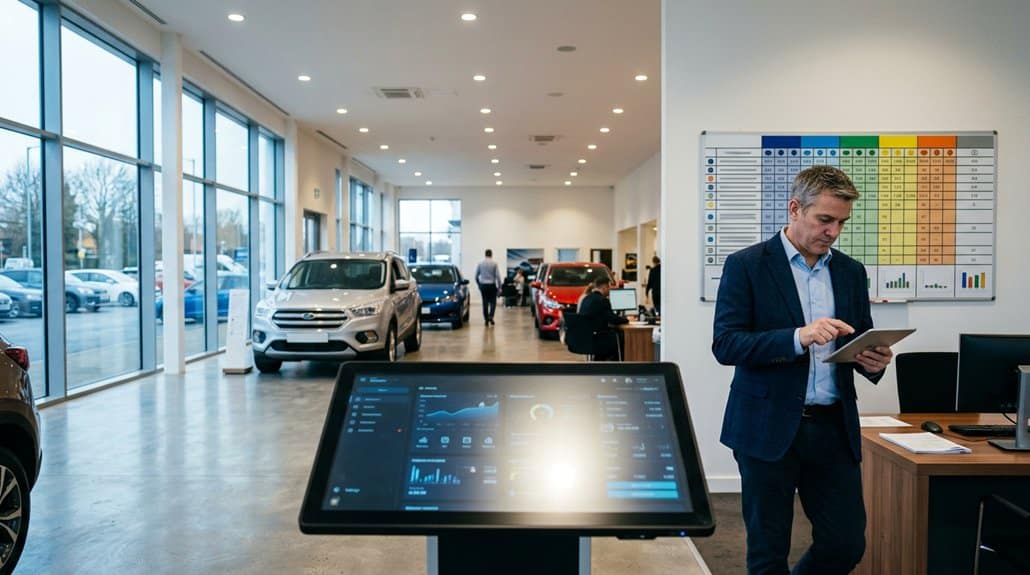
Think of this as an operational playbook: start by auditing your data sources and integrating your DMS/CRM so field mappings (price, VIN, photos, status) are exact—this prevents the common listing errors that eat hours and erode trust. Next, define rules for triggers (new trade, price change, sale) and test in a sandbox. Train staff on exception workflows and rollback procedures to handle edge cases.
| Step | Focus |
|---|---|
| 1 | Data audit & mapping |
| 2 | Trigger rules & automation |
| 3 | Sandbox testing |
| 4 | Training & exceptions |
This sequence targets workflow benefits: reduced manual hours, consistent listings, real-time updates. Anticipate implementation challenges around legacy DMS access and staff adoption; mitigate with phased rollout and metrics-driven checkpoints.
Measuring ROI: Time Saved, Lead Conversion Lift, and Revenue Impact
Having completed the automated sales-board rollout steps, now quantify what the system delivers: track hours reclaimed, conversion lift, and incremental revenue so you can justify the investment and guide further optimization. You’ll measure time efficiency by logging the average 20 hours/month saved and reallocating that labor to sales activities. Track lead conversion lift—automation can cut response times and boost conversions up to 391%—and model revenue growth from higher conversions and accuracy.
Quantify the rollout: log 20 hours/month saved, measure conversion lifts and incremental revenue to prove ROI.
- Monitor reclaimed hours, reduced labor costs, and redeployed staff time for direct selling.
- Measure conversion rate improvements and translate percentage lift into monthly closed deals and incremental revenue.
- Track listing accuracy, online visibility gains (~25%), and resultant sales increases (up to 15%) to compute ROI.
Frequently Asked Questions
What Is the Red Flag Rule for Auto Dealers?
The Red Flag Rule requires you to detect red flag indicators, verify customer data, implement a written identity-theft program, train staff, and take corrective action—ensuring dealership compliance, reducing fraud risk, and improving operational efficiency and audit readiness.
What Are 10 Things Not to Say at a Car Dealership?
Don’t say: “I’m just browsing,” “What’s your best price?” “I’ve seen this cheaper elsewhere,” “I want to think about it,” or request a make/model without budget — hindering car buying, negotiation strategies, pricing transparency, financing options, vehicle inventory.
How to Counter the Manipulative Sales Tactics of a Car Dealer?
You counter manipulative sales tactics by documenting interactions, leveraging ethical sales benchmarks, asserting consumer rights, requesting transparent pricing, comparing market data, setting clear decision timelines, and using efficient negotiation scripts to minimize pressure and optimize outcomes.
Who Is Above a Sales Manager at a Dealership?
Above a sales manager you’ll typically report to the General Sales Manager or Sales Director; Dealer Management Hierarchy also includes Dealer Principal or Regional Manager. Sales Director Responsibilities focus on performance metrics, strategy, compliance, and operational efficiency.
Conclusion
Don’t keep burning manager hours on manual sales-board updates when automation shaves that work down dramatically. Studies show dealers using automated workflows cut update time by up to 70%, freeing managers for higher-value tasks like closing deals and coaching teams. Turn on real-time listings, eliminate errors that lose leads, and watch response times drop while conversions rise. Small setup effort, measurable time and revenue gains — treat automation as an operational imperative, not an optional convenience.