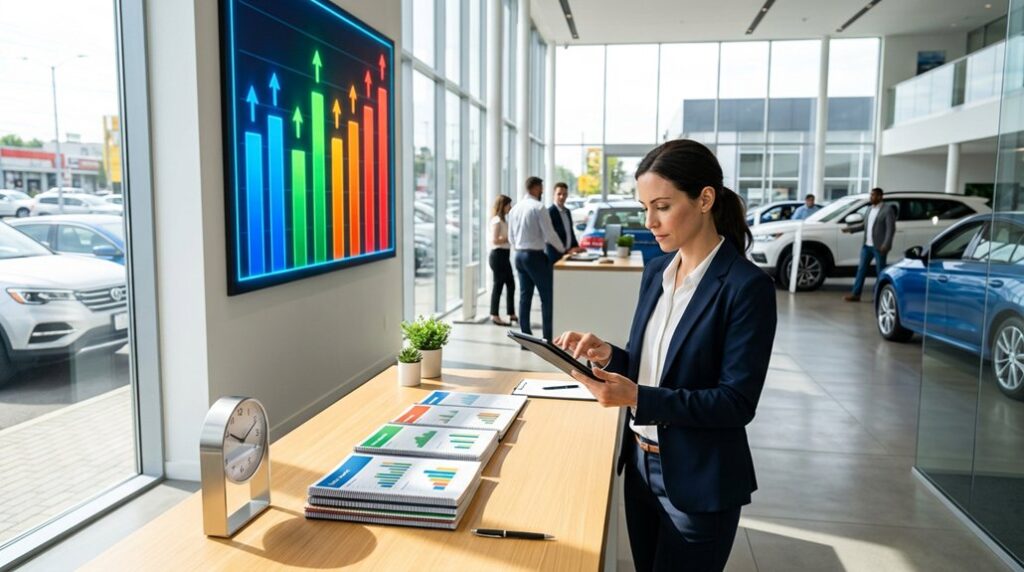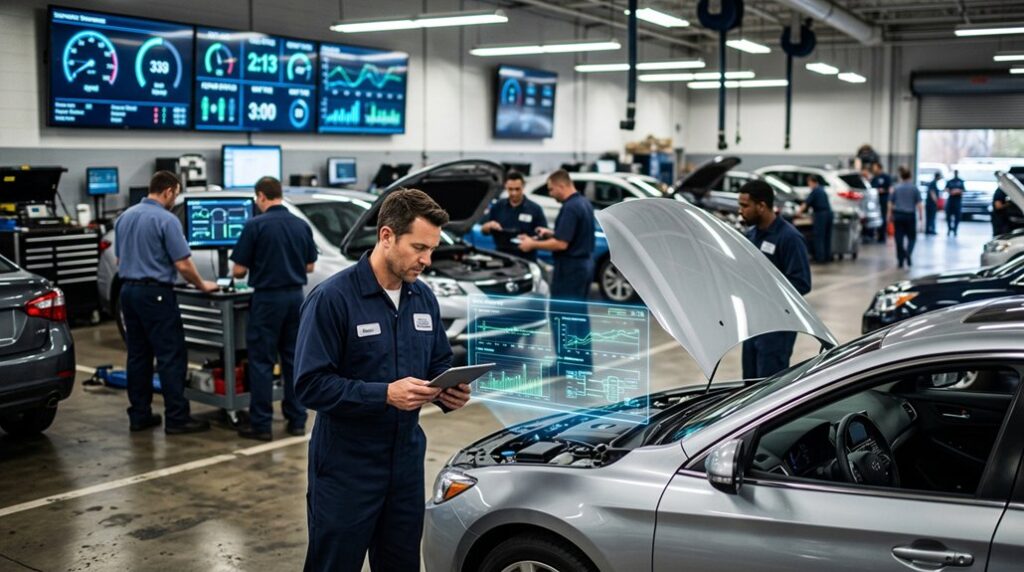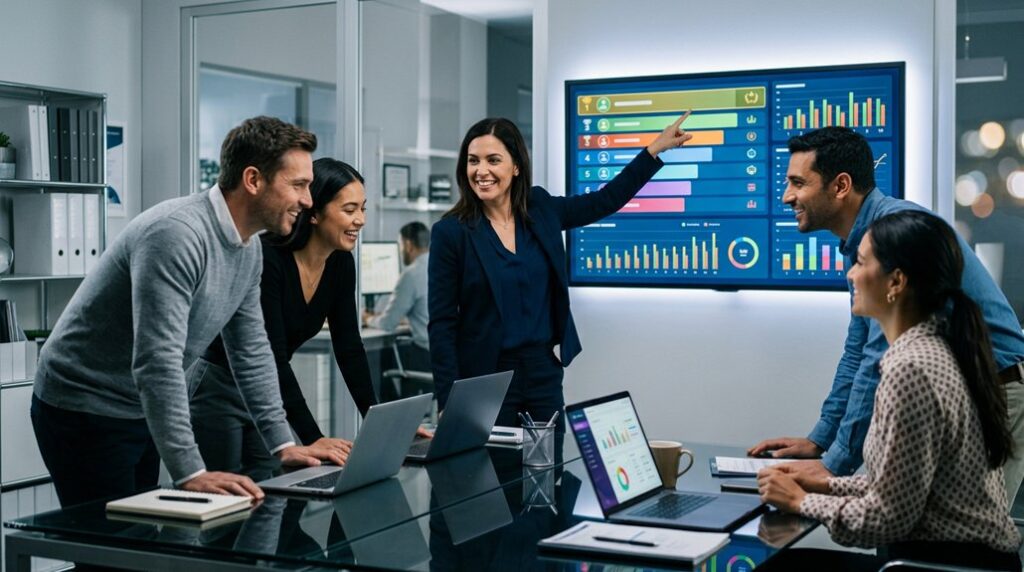
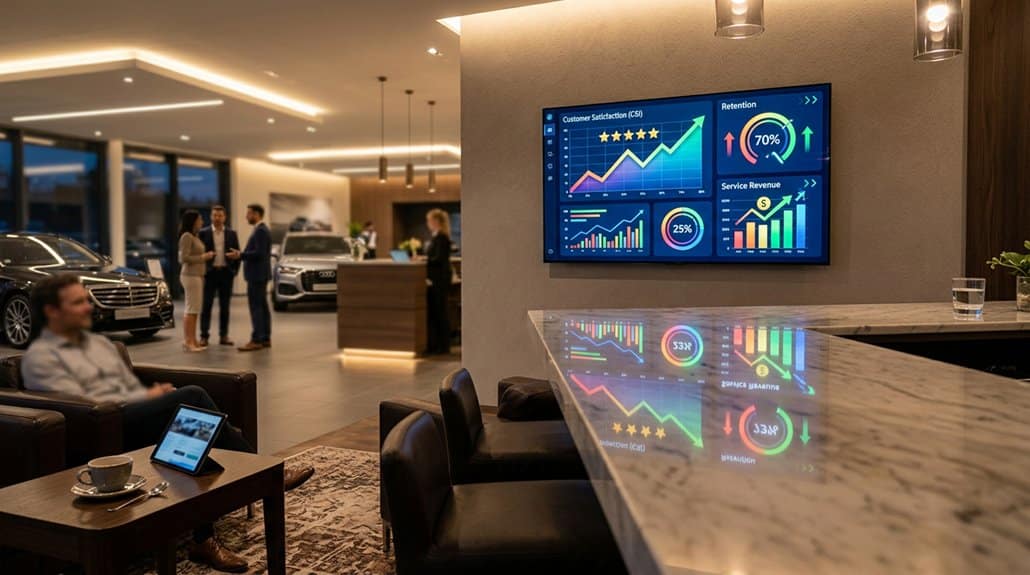
You can cut perceived wait times by up to 33% and lift CSI by showing real-time service updates, technician ETAs, and branded short education clips that explain repairs. Tie Lounge TV to your DMS/CRM for personalized maintenance reminders, targeted loyalty offers, and timely upsell CTAs that raise average repair orders and return rates. Track viewer retention, CTA interactions, and break-even sensitivity to prove ROI — keep going to see templates, KPIs, and implementation steps.
Key Takeaways
- Real-time service updates on Lounge TV reduce perceived wait times and increase trust, boosting CSI and reducing front-desk interruptions.
- Educational maintenance clips and branded tips build credibility, drive repeat bookings, and increase average repair order value.
- Targeted loyalty offers and time-limited service specials displayed in the lounge create urgency and improve appointment conversion rates.
- Integration with DMS/CRM enables personalized status screens and reminders, increasing retention and relevant upsell opportunities.
- KPI dashboards and A/B testing of Lounge TV content track viewer engagement and ROI, optimizing revenue and CSI impact.
How a Lounge TV Boosts CSI, Retention, and Revenue (Quick Wins)
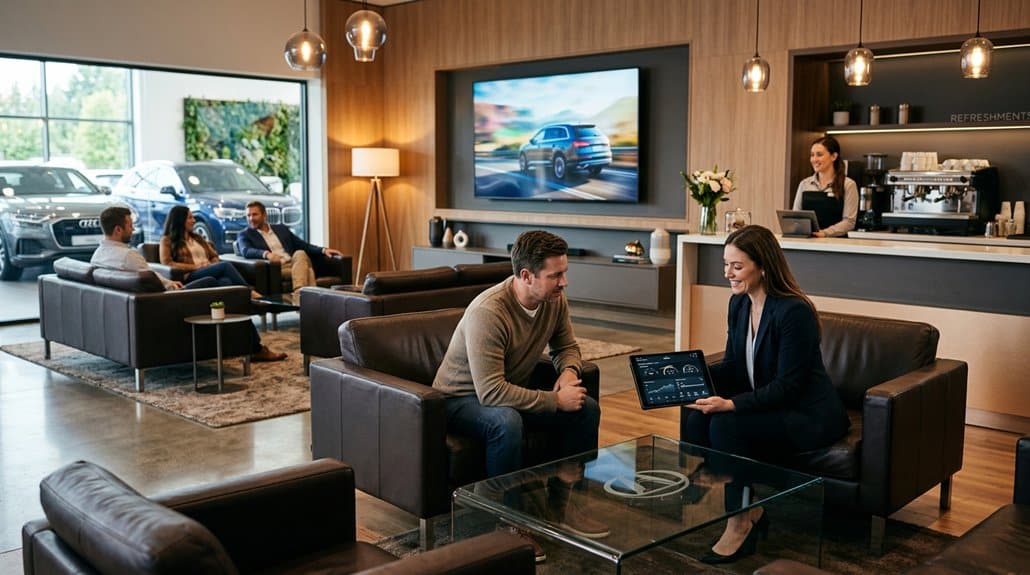
While customers wait, a well-programmed lounge TV can cut perceived wait times by up to 33%, directly lifting CSI scores by reducing frustration and increasing perceived service value; combine that with real-time service status displays, and you both lower anxiety and create upsell moments that drive retention and incremental service revenue. You’ll measurably improve customer engagement by showing timely service updates, targeted promotions, and short, family-friendly segments that keep attention without interrupting workflow. Trackable metrics—dwell time, promo click-throughs via QR codes, and repeat-service rates—show quick ROI: higher CSI, increased average repair order, and stronger retention. Use consistent visual storytelling and customized branding to reinforce loyalty and convert idle attention into actionable service revenue.
7 Lounge TV Content Types That Drive Repeat Service Visits
You’ll drive more repeat service visits by combining real-time service updates, concise maintenance education clips, and exclusive service specials into your lounge TV rotation. Data shows clear updates reduce anxiety and perceived wait times by up to 33%, while short educational content and time-limited offers increase trust and spur immediate bookings. Prioritize frequent content refreshes and measurable CTAs so you can track increased return rates and service revenue.
Real-Time Service Updates
Because real-time service updates on lounge TVs can cut perceived wait times by up to 33%, they’re a high-impact tool for boosting satisfaction and repeat visits—showing customers live status, ETA adjustments, and mechanic notes builds transparency and trust while keeping engagement high. You’ll use visual status bars, timestamped progress, and concise mechanic notes to deliver measurable service transparency that reduces anxiety and increases Net Promoter Scores. Update frequency, clear ETA deltas, and color-coded stages let you quantify improvements: fewer inquiries to advisors, shorter perceived waits, and higher conversion on service specials. By eliminating competitor ads and focusing on dealership-specific updates, lounge TVs drive targeted customer engagement, reinforce your brand, and create a predictable path to improved retention and incremental service revenue.
Maintenance Education Clips
If you want customers to return, maintenance education clips on lounge TVs are a high-ROI touchpoint: concise, visual tutorials about oil changes, tire care, brake wear, and filter replacement increase understanding and trust, and studies show education can raise the probability of a customer buying their next vehicle from you by 74%. You’ll use short, data-backed segments to debunk maintenance myths, explain service intervals, and show measurable impacts on vehicle longevity. Visuals cut perceived wait times by up to 33%, improving CSI and increasing repeat bookings. Update clips regularly and tailor content to common service needs to differentiate your dealership, reinforce expertise, and create tracked lift in retention and service revenue. Measure view rates, appointment conversions, and rebook percentages.
Exclusive Service Specials
One clear way to drive repeat service visits is to run exclusive, time-limited specials on your lounge TVs that combine visually engaging offers with measurable calls-to-action; targeted promotions like these have been shown to lift repeat visits by up to 39% when updated regularly and framed with immediate booking cues. You should schedule frequent content refreshes so patrons see new exclusive promotions on arrival, creating urgency and measurable lift in bookings. Use bold visuals and short benefit bullets — e.g., discounts on routine maintenance — plus QR codes or short booking numbers to convert attention into appointments. Pair specials with family-friendly programming to sustain positive customer engagement while increasing foot traffic. Track redemptions, visit frequency, and revenue during campaigns to quantify ROI and optimize timing.
Show Real-Time Service Status via DMS Feeds
You’ll boost transparency and reduce inquiries by streaming live service updates from your DMS directly to lounge TVs. Data shows real-time status displays can cut perceived wait times by about 33% and free advisors to focus on higher-value interactions. That measurable uplift in satisfaction and operational efficiency drives repeat visits and service revenue.
Live Service Updates
Because real-time DMS-fed service updates give customers minute-by-minute visibility into their vehicle’s progress, they cut perceived wait times by up to 33% and directly reduce front-desk interruptions, freeing staff to focus on higher-value tasks. You’ll boost customer engagement and service transparency by streaming technician status, parts orders, and estimated completion times on lounge TVs. That reduces anxiety, increases trust, and raises repeat-business likelihood. Measurable outcomes include fewer service-counter queries, higher CSI scores, and improved retention.
| Metric | Impact |
|---|---|
| Perceived wait time | -33% |
| Front-desk calls | -40% |
| CSI score lift | +X points |
| Repeat visits | +Y% |
| Staff productivity | +Z% |
Integrate DMS feeds, set update frequency, and monitor KPIs to prove ROI.
DMS-Driven Transparency
Following real-time service updates on lounge TVs, the next step is to surface those DMS-fed statuses directly to customers so they can monitor progress without asking staff. You’ll display live stages—check-in, inspection, repair, quality control, ready-for-pickup—pulled from your DMS, reducing perceived wait times by up to 33% and cutting status inquiries. Use timestamped entries and percentage-complete indicators to quantify progress; track reduction in call volume and increases in repeat visits to measure ROI. This transparency drives customer engagement and builds measurable service trust: informed customers report higher satisfaction and are likelier to return. Operationally, staff reclaim time for service quality instead of updates, improving throughput and contributing directly to retention and service revenue gains.
Create Branded Educational Spots That Increase Perceived Value
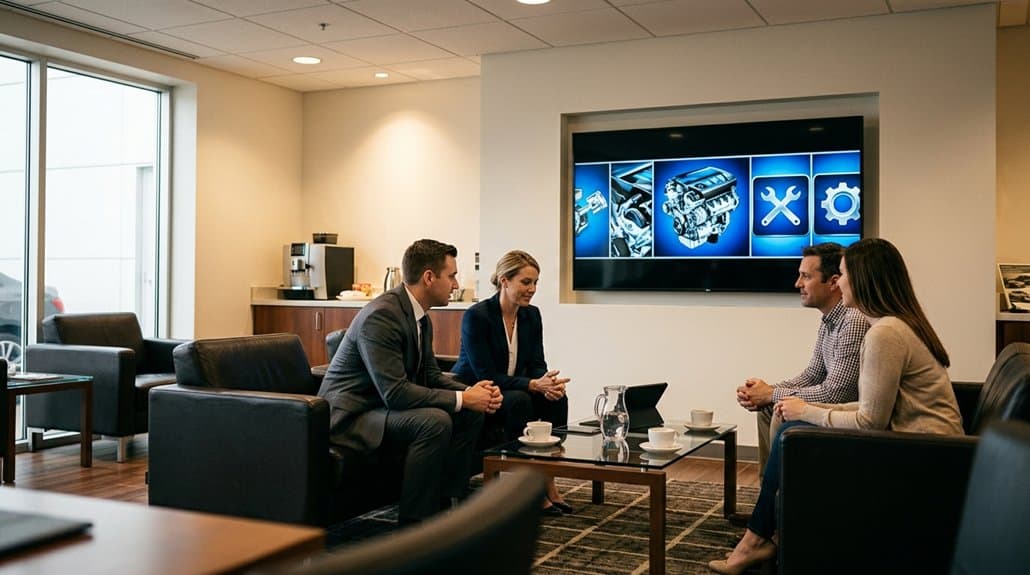
When guests wait in your service lounge, short branded educational spots can cut perceived wait times by as much as 33% while simultaneously raising the perceived value of the visit; you should deploy concise, dealership-branded storytelling that targets common service questions and showcases maintenance benefits. Use customer education clips—60–90 seconds—with measurable calls-to-action and track view frequency and retention metrics. Rotate content monthly to prevent fatigue and improve engagement rates; dealerships that refresh spots see higher perceived value and repeat-booking signals. Emphasize technical credibility (certified techs, OEM parts) to build trust and retention. Combine maintenance tips with clear service offerings to convert awareness into revenue. Measure CSI lift, return visits, and service ticket increases to validate ROI and optimize content strategy.
Integrate Lounge TV With DMS/CRM for Personalized Messaging
You can link Lounge TV to your DMS/CRM to push real-time service status updates that cut customer uncertainty and shorten perceived wait times. Use customer history to trigger targeted maintenance reminders and model-specific specials, which data shows increases service upsell rates. Automating loyalty-based promotions based on profile segments streamlines staff workflow and drives measurable gains in CSI and retention.
Personalized Service Status
Because Lounge TV can pull real-time data from your DMS and CRM, it delivers tailored service-status updates that cut uncertainty and keep customers informed every step of the way. You’ll reduce customer anxiety and increase service transparency by showing individualized progress: check-in complete, technician assigned, inspection in progress, parts ordered, estimated completion. Data shows digital vehicle inspections displayed visually on Lounge TV boost trust because customers see issues and proposed fixes, not just hear about them. Personalized status feeds correlate with higher CSI and retention: timely, relevant updates make waits feel shorter (perceived wait times drop up to 33%) and lift satisfaction scores. Implemented correctly, this integration converts transparency into measurable revenue through repeat visits and stronger customer relationships.
Targeted Maintenance Reminders
Although it’s often overlooked, integrating Lounge TV with your DMS/CRM lets you push targeted maintenance reminders that are timed and tailored to each vehicle’s service history, mileage, and open recalls—reducing missed appointments and increasing return visits. When you surface personalized messaging on Lounge TV in real time, you convert service data into actionable prompts that improve customer engagement and transparency. Metrics show tailored reminders cut no-shows and lift return rates; displaying upcoming service needs and recall alerts while customers wait increases consent rates and average repair order value. You’ll drive higher CSI by reducing surprises and demonstrating proactive care. Implement rule-based triggers (mileage thresholds, time-since-service, open recalls), track reminder-to-visit conversion, and iterate messaging for measurable retention and revenue gains.
Loyalty-Based Promotions
Building on service reminders, Loyalty-Based Promotions let you turn those same DMS/CRM signals into targeted offers that reward repeat behavior and boost repair order value. You’ll push personalized loyalty incentives to Lounge TV based on service history, vehicle type, and recent customer feedback, increasing relevance and conversion. Real-time status screens plus tailored discounts reduce anxiety and encourage add-ons, measurable as higher average RO and retention rates.
- A VIP coupon for customers with 3+ visits this year, shown while waiting.
- Time-sensitive oil-change bundle for vehicles near mileage thresholds.
- Loyalty-point reminders tied to next-service recommendations.
- Post-service survey prompt with a follow-up offer based on response.
This data-driven loop turns engagement into measurable revenue and improved CSI.
Sell Targeted Ads & Local Sponsorships to Grow Service Revenue
One clear way you can boost service revenue is by selling targeted ads and local sponsorships on your lounge TVs, since well-curated content can cut perceived wait times by up to 33% and makes customers more receptive to offers; use advertising partnerships informed by customer demographics to match sponsors to audience segments. Track view duration and click-through rates to create tiered pricing that aligns cost with measured attention, and rotate sponsors with regularly updated service specials to sustain engagement. Local sponsorships generate incremental revenue while reinforcing community ties and enhancing perceived value, which improves retention. Measure lift in appointment uptake and average repair order after campaigns to quantify ROI, optimize inventory of ad slots, and present data-backed pitches to local vendors.
Program Templates: Daily Schedules for Maximum Engagement
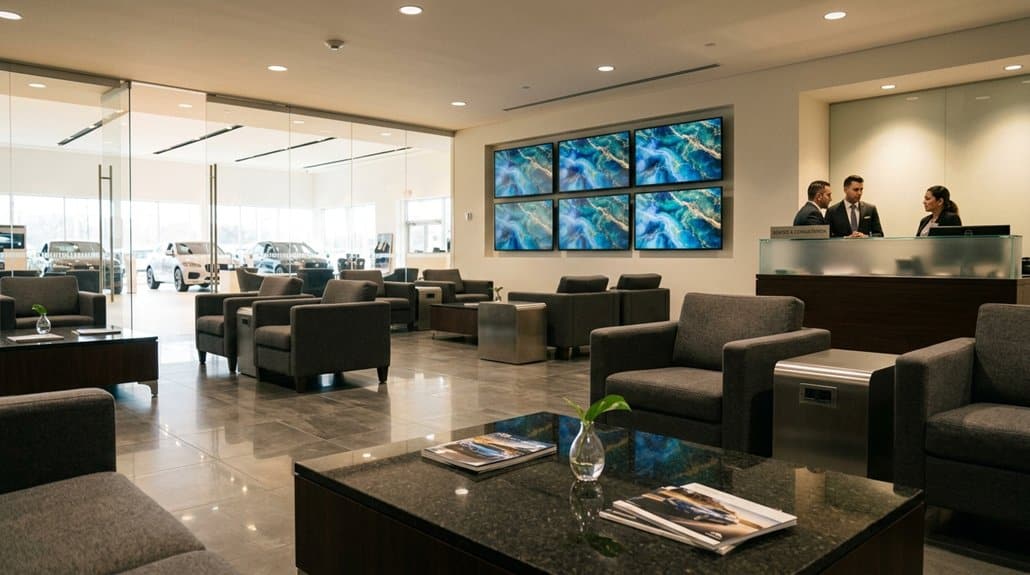
Start with a predictable, data-backed rhythm: a morning block of brief service-status updates and quick how-to clips, a midday rotation of family-friendly entertainment and targeted service offers, and an afternoon sequence emphasizing community events and loyalty prompts—this structure leverages the 33% reduction in perceived wait time and keeps messaging fresh while maximizing measured view duration and conversion. You’ll design templates that balance program diversity with consistency, schedule real-time status intervals, and insert short promos tied to service specials. Use audience feedback to refine lengths and sequencing for retention and CSI gains. Example daily template imagery:
Start with a predictable, data-driven schedule: morning status and how-tos, midday family content and offers, afternoon community and loyalty prompts.
- Morning: 5–7min status + 3min how-to clips
- Midday: 20–30min family content + 2–3 targeted offers
- Afternoon: community features + loyalty prompts
- Evenings: recap loop and service reminders
Measure Lounge TV Impact: KPIs, A/B Tests, and Attribution
When you want to prove Lounge TV’s value, focus on a tight set of KPIs—viewer retention, average view time per visit, CTA click or scan rates, upsell conversion from promos, and CSI change—then track them against baseline service revenue and wait-duration metrics to quantify lift; use viewer analytics to establish baselines and segment by visit type. Run A/B tests on programming effectiveness and content optimization—swap creative, pacing, and CTAs—to isolate what drives longer view times and higher conversion. Combine performance metrics with structured customer feedback to validate perceived wait-time reduction and refine retention techniques. Report uplift in service revenue and CSI attributable to specific engagement strategies. Use these data driven decisions to iterate quickly and scale winning templates across locations.
Common Implementation Pitfalls and How to Avoid Them
Although you might assume installing lounge TVs is mostly plug-and-play, common implementation missteps — weak content curation, poor system integration, neglected updates, inadequate staff training, and overlooked ADA requirements — directly erode the metrics you care about: engagement, perceived wait-time reduction (up to a 33% decline if content isn’t engaging), CTA interaction rates, return visits, and CSI. To avoid pitfalls, focus on measurable controls: rigorous content scheduling, automated technology updates, clear staff training protocols, and ADA compliance checks. Track engagement metrics and collect customer feedback to iterate. Address integration challenges up front to preserve brand consistency across displays and the service environment. Use maintenance strategies to prevent stale playlists and maintain real-time vehicle-status tie-ins for higher retention and revenue.
Weak content, poor integration, missed updates, and neglected ADA/training quietly destroy engagement, CTAs, returns, and CSI—measure and maintain.
- Curate relevant, rotating content tied to KPIs
- Validate system integration and sync
- Run regular tech and ADA audits
- Train staff on usage and feedback loops
Quick ROI Checklist: Costs, Expected Gains, and Rollout Timeline
Because a clear ROI framework ties costs to measurable gains, your checklist should open with setup and recurring expense line-items, paired with conservative and upside revenue/CSI projections and a phased rollout timeline; include hardware, mounting, CMS licensing, content production, integration labor, ADA compliance checks, staff training, and a 12–24 month maintenance reserve. Itemize one-time vs. annual costs, run a cost analysis showing payback at conservative 10–15% service-revenue lift and upside 25–35% when sponsored content is added. Quantify CSI impact (use up to 33% perceived wait-time reduction) and model retention/value per retained customer. Define a 90–180 day pilot, 6–12 month scale, and 12–24 month optimization window tied to content strategy, KPI dashboards, and break-even sensitivity testing.
Frequently Asked Questions
Why Is Customer Retention Crucial in CRM and How Can Businesses Develop Effective Customer Retention Plans Based on Customer Defections?
You need retention because customer loyalty costs far less than acquisition; retention strategies cut churn, boost lifetime value, and raise revenue. Analyze defection drivers, track repeat-service metrics, personalize follow-ups, and A/B test offers for measurable results.
How to Maximize Customer Retention?
Promptly prioritize personalized programs: persistently promote loyalty programs, capture customer feedback, analyze churn metrics, optimize offers, automate targeted outreach, measure retention rates, refine service touchpoints, and report ROI to guarantee data-driven, results-focused relationship growth.
What Is CSI Service Advisor?
A CSI service advisor is the staff member who manages service satisfaction, tracks CSI metrics, uses customer feedback to improve processes, and undergoes advisor training to drive measurable improvements in retention, loyalty, and service revenue.
How to Grow a Car Dealership Business?
You grow a car dealership by boosting customer engagement, using data-driven service promotions, optimizing online scheduling, training technicians, enhancing lounge experience, and tracking CSI metrics to increase retention, repeat revenue, and measurable service profitability.
Conclusion
You’ll see lounge TV act like a silent closer, boosting CSI, retention, and service revenue by presenting timely, personalized messages tied to your DMS/CRM. Track KPIs (wait times, return visits, average repair order) and run A/B tests to prove impact; expect measurable uplifts within 60–90 days. Use templates, avoid common pitfalls, and follow the ROI checklist to keep costs predictable and results-driven—turning passive wait time into profitable engagement.